

BETWEEN STATIONS
It plays all the time, yesterday, today, tomorrow, the day after. This song goes on and on and on, saturating space, bombarding earth. Huge and always in-rotation, you could say it’s the cosmic disk jockey’s favorite tune. Only, this song is not particularly tuneful; there is no discernible melody. It’s more like a portable radio stuck between stations, out of tune, broadcasting static, hiss, and fizz: ssssssssssssssssssssssssssss!
“We strive to stay on station, resisting the in-between. Our signal is aimed. It has targets”
Man-made radio is different. Unlike cosmic radio, human radio is meant to be tuned, and, when done right, it is tuneful. We strive to stay on station, resisting the in-between. Our signal is aimed. It has targets. Someone is meant to receive. And we send and receive all the time. Radio, television, phone calls, computers, GPS, all are forms of radio.
Case in point, on a chilly night in Oregon, pulling down a particularly strong signal, his receiver aimed, is one Portland resident, Santiago Diego Carmona Barrenechea.
Call him Santi.
Santi steps outside into the night and adjusts a homemade antennae. The device, stuck atop a plump shrub, is cobbled together from scraps of metal, wire, and, most strange, strings of red beads. Although it looks every bit an art object, Santiago reassures tonight’s house guests that the thing is functional. That “yah yah, it works.” Inside his apartment, as proof positive, the receiver grabs radio signal from the antennae, and out the stereo speakers rages the message of punk rock. Ahhhhhhhhhhhh!
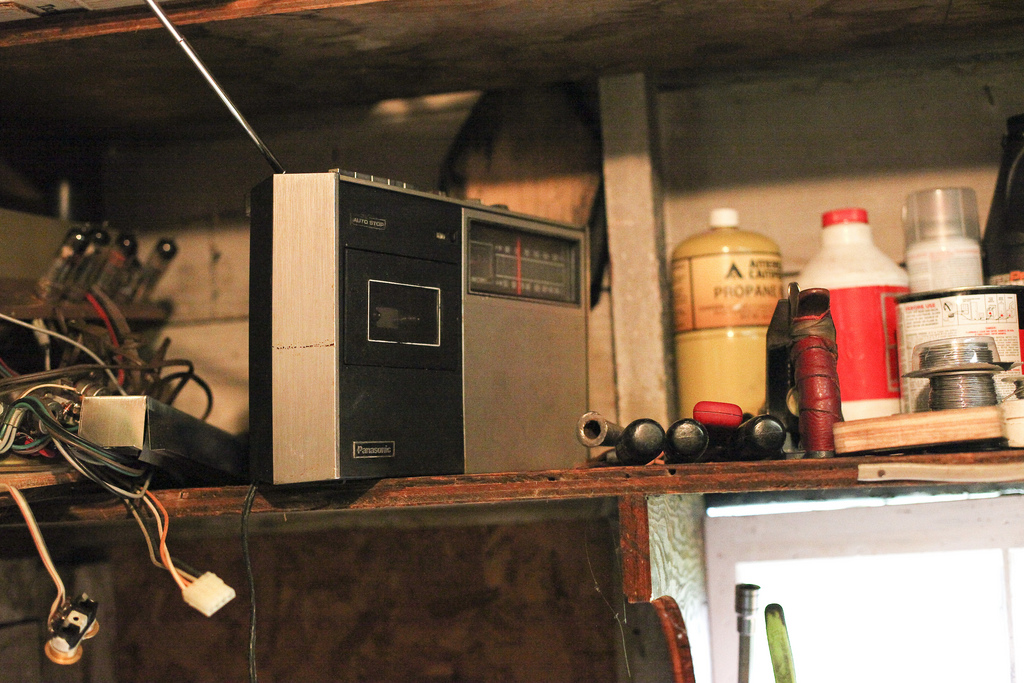
A salvaged Panasonic receiver, antenna up, on the workshop shelf.
A REVOLUTIONARY VIEW
Pirate radio is the sexy title given to unlicensed broadcasting. Santi, born and raised in Argentina, spent his early adult years in Mexico working on just such bootleg radio stations, a very real and romantic cause.
Sharply contrasting the image of blood-thirsty marauders dedicated to plunder, the pirate in pirate radio can many times actually be an honest-to-goodness do-gooder. These well meaning souls are often motivated by little more than an inability to afford the economic price, or, sometimes the seriously costly, political price of legit radio. A radio Robin Hood, a pirate gives rather than takes. And what the pirate radio jockey gives can be of real benefit to locals. A home for ideas and music and culture and outreach, a hookup for the homespun, a rallying point for community.
“...Menacing automatic weapons and rubber shoes that came in a variety of jolly colors”
Santi was fascinated by exactly that. So much so that he spent years building and maintaining stations all over Mexico. Working with other Mexican pirates, Santi became a crackerjack pirate radio engineer. He and his friends amassed a reputation. Their celebrity carried far enough that Subcommandante Marcos, a real outlaw, risked a visit to them. Marcos, leader of the Zapatista Liberation Army, a movement defending Oaxacan peasants against powerful and longstanding oppression, is a man used to leveraging limited resources. He and his rag-tag army brought about some of the most significant changes in Mexican politics in the last century. Hearing about Santi and company, the Subcommandante rationalized his traveling north, which included being followed by secret police in many colored rubber boots, with a solid compliment. “I hear from many people that they can make a radio transmitter out of a tree branch.”
Well, not exactly, according to Santi. But close enough.
While the visit struck Santi as serious, to say the least, the rebels rather jovially spent time buying phone cards and booze. While the police, who followed the rebels constantly, they wore, along with menacing automatic weapons, rubber shoes that came in a variety of jolly colors. Orange, red and blue.
A SWASHBUCKLING PIRATE
This wasn’t the only time Santi got swept into serious Mexican politics. An occasion in 2007 was the closest he has come to feeling like a swashbuckling pirate. During this episode, after having entered the city in a somewhat clandestine manner, Santi was performing a radio installation, in middle of the night, on the roof of a building, overlooking Oaxaca City. In the streets below, the city sparked with scattered fires, protests, riots.
“Santi did the only reasonable thing under the circumstances. He bought a six-pack.”
Eerie silhouettes scuttled about the surrounding rooftops. Eyeballing the shadows, Santi hesitated to begin, thinking to himself, This is fucking scary. He stared down at the transmitter gear awaiting his attention. He grumbled to the night air. “Do I want to be climbing a radio tower,” he said, “if there are snipers about? What have I got myself into?”
He’d got himself into a lot. The year preceding, Oaxaca City police attacked protesters during a teachers union strike. As many as one hundred people may have been injured. Citizens rebelled. The Popular Assembly of the Peoples of Oaxaca (APPO), a citizen group, took over part of the city. The APPO challenged city government authority, which they considered corrupt, and continued to do so over the course of that year. The nation’s president got involved. People died in the conflict. Radio communication had been important to the APPO cause, and Santi, who had received a request by them to set up a radio station on the conflict’s one-year anniversary, was flown into the city under special auspices, snuck through customs, along with his equipment, in quasi secret.
And now he was under deadline, and, if unlucky, possibly under fire. The first broadcast was scheduled for early morning. Given that was already after midnight, and he was just getting started, Santi did the only reasonable thing under the circumstances. He bought a six-pack. Returning, Santi cracked a beer, looked out toward the fires in the city below, and set to work. The beer performed its magic. Hours later, with the sun coming up, the job was complete. Santi paused and considered the situation in a new light.
It’s nice view, really.
Then he got the hell outta there.
RADIO TARGETS…
Oaxaca City was the culmination of seven years in pirate radio. Santi felt due for a change. Fleeing the radio tower before things got too hot, when the broadcast went live, he was about to get that change.
Later that evening, decompressing in bar, Santi meets a girl, Mary-Rain O’Mera of Portland, Oregon. Mary-Rain is attracted to the stranger’s blend of the serious and the free-spirited. The feeling is mutual. They dance. A romance begins. As fortune would have it, they are both living in Mexico at the moment and are able to spend a lot time together. But time passes, and Mary-Rain must return to Portland. Cell phones allow them to stay connected. The calls are radio waves, signals with a target, signals aimed at someone, someone who is meant to receive.
Man-made radio transmissions are escaping, all the time, through the earth’s atmosphere, where they continue into space, on and on, passing asteroids, planets, stars. Out there, in vast enigma of the universe, are commercials for wedding dresses and posture-correcting mattresses, fast food and hair removal, old broadcasts of AD/DC and the Wipers, talk show vitriol, news of the world, reruns of Frazier. Among the cosmic flotsam, too, are personal communications: gossip, disputes, seductions, happy birthday to mom. While the universe bombards us with its programming, its static’s song, it seems that we, in turn, shoot back with our own programming, a farrago of human noise.
Also among the noise are the many calls between Santiago Diego Carmona Barrenechea and Mary-Rain O’Meara: calls that began by bridging a sizable distance, between Mexico and the U.S., until, one day, calls were placed from close range, and there they remained… in the same city. Portland, Oregon.
“Other people’s trash is Santi’s source of inspiration”
STEAMPUNK SANTI
In a Portland living room, Mary-Rain, moved-in-with and married-to Santi, leans over a vintage sixties-era stereo console. Opening the polished wood lid, and, reaching in to the place normally housing the record player, which has been removed, she chooses music from a makeshift tablet screen, picking out songs from a long list of artists and albums on a digital display screen. She hits play. Out of the cabinet comes blasting an assortment of Spanish language punk rock, funky Cumbia, and lesser known alternative acts. Mary-Rain adjusts volume using the original plastic knobs.
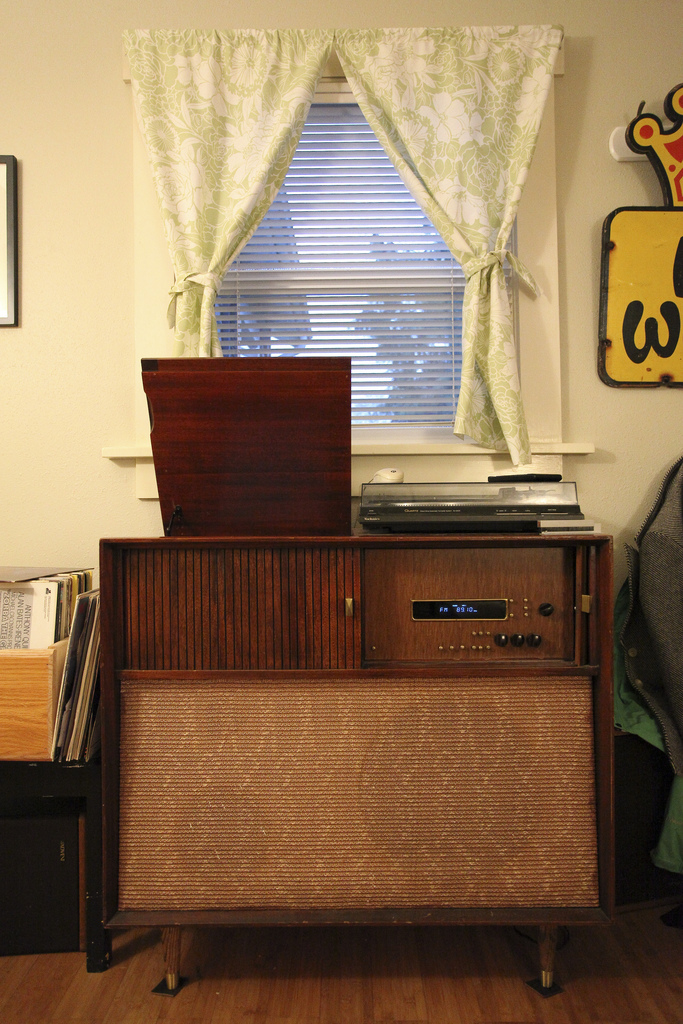
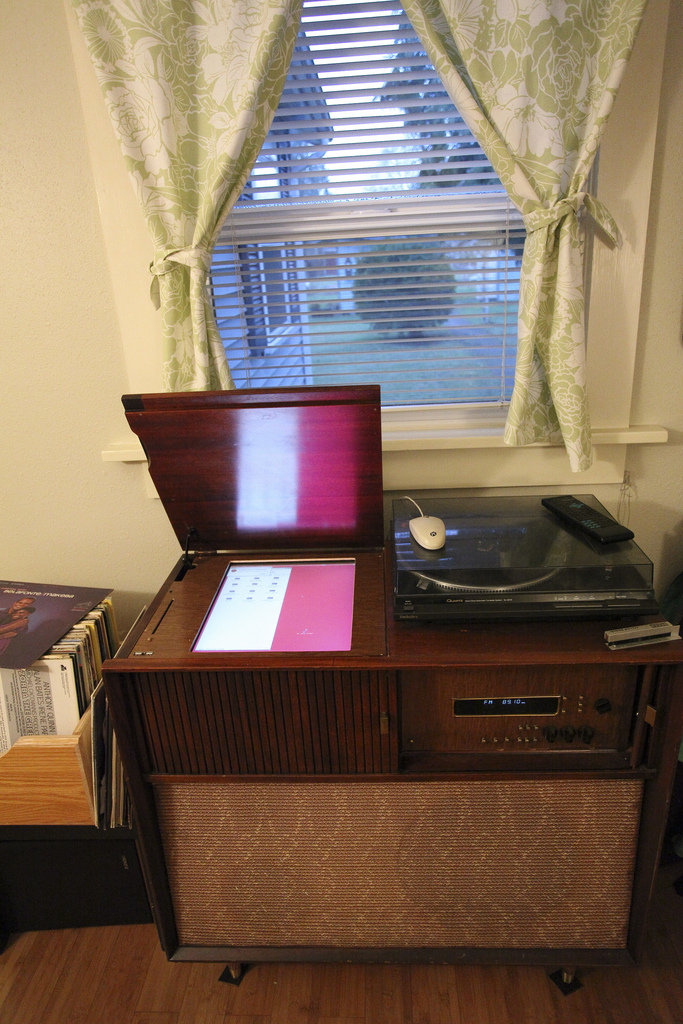
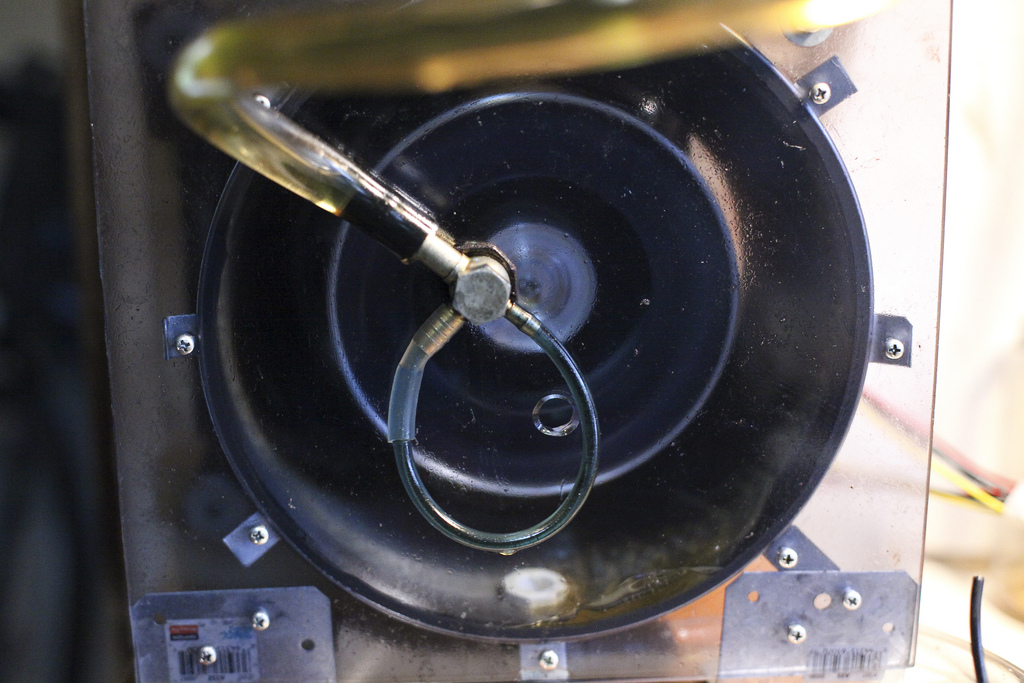
Click any image to view the gallery.
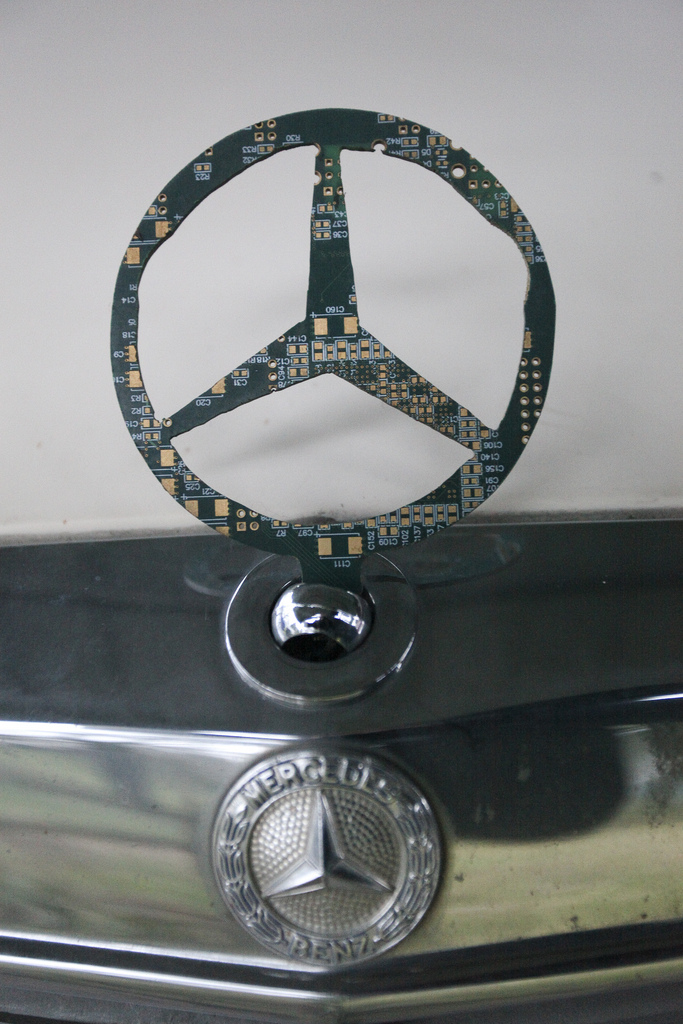
Santi, his pirate radio days behind him, has metamorphosed into inventor of devices conceived from salvaged junk, scraps, and the second-hand, a reuse artist. The hybrid stereo console is one of his trademarks: a Frankenstein mongrel mixing older discarded technology with newer discarded technology. Other people’s trash is Santi’s source of inspiration. Whether it’s resurrecting straight razors using silicon chipboards for handles, distilling motor oil out of spent restaurant vegetable grease, cobbling together electric guitar amplifiers out of stereo cabinets, or reanimating and reconfiguring a lifeless lead-burning Mercedes into diesel daily driver, nothing gets wasted.
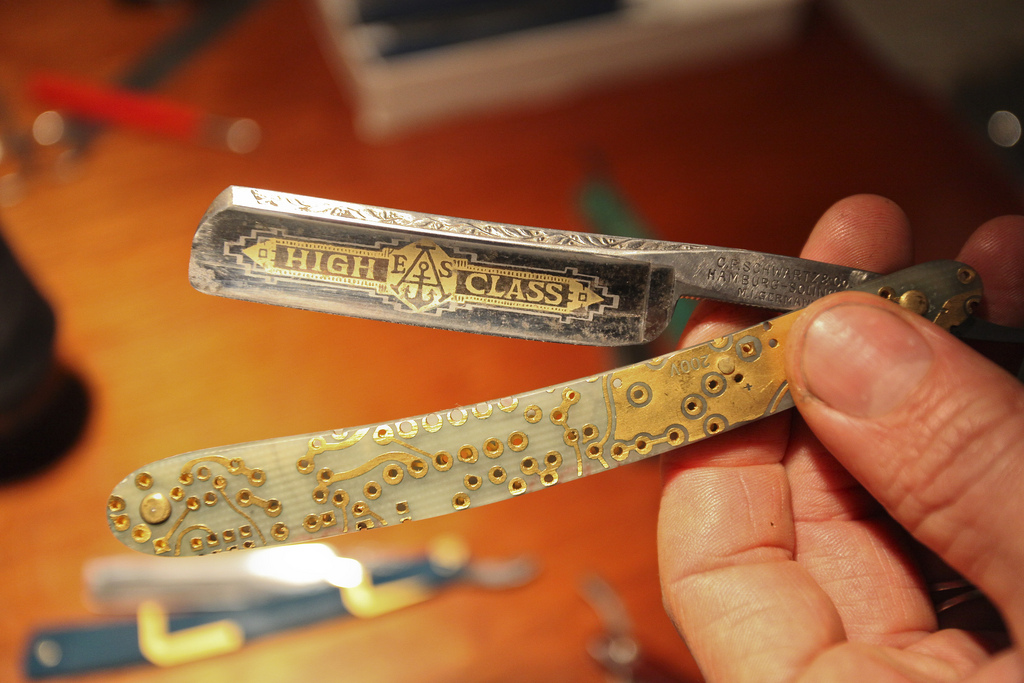
A straight razor resurrected with a handle of silicon chipboard.
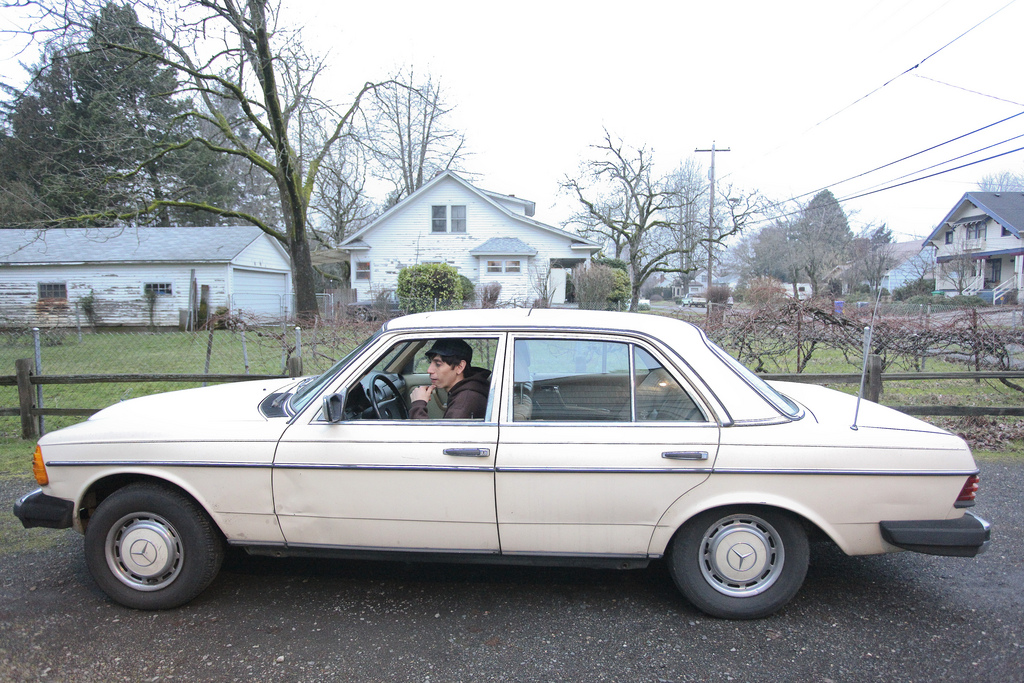
The lead-burning Mercedes, reconfigured into a diesel daily driver.
The living room tonight is replete with guests, the music plays festively. It’s Santi’s birthday. Santi carries in a homemade Argentine-style pizza, fresh from the oven. He smiles. “Here’s some pizza,” he says, setting the pie on the coffee table.
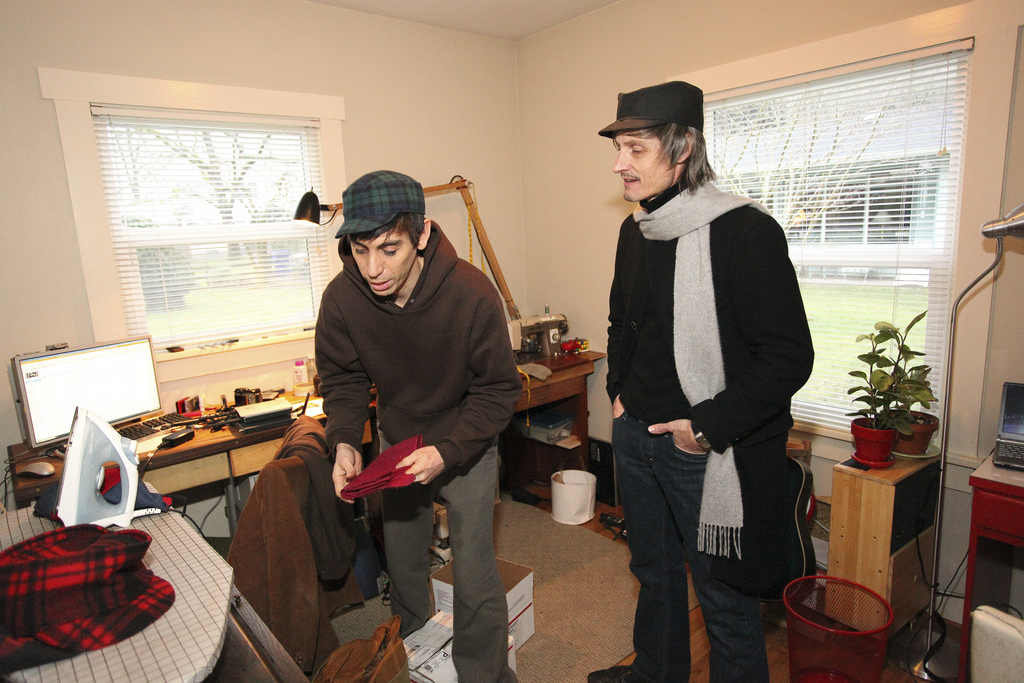
Santi shows off red plaid reuse fabric in the living room.
“Santi has been making hats!” Mary-Rain announces, amused and amazed, to the people in the room, pointing at her husband’s head. The hat is a red and black plaid, made from reuse fabric.
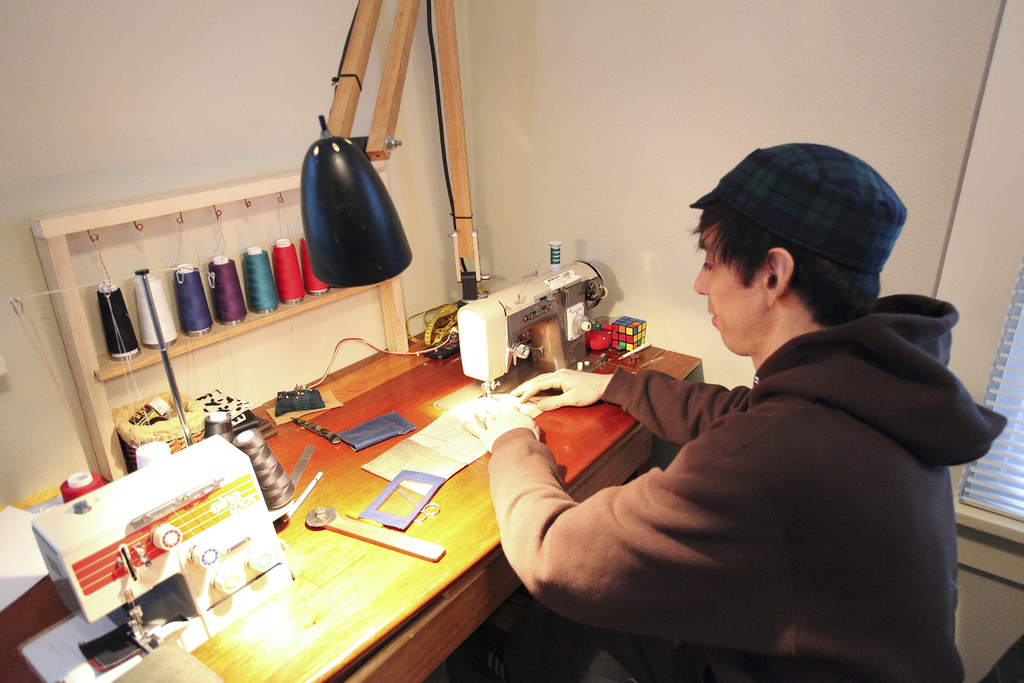
Making hats at the Elna overlock machine.
It’s a great hat, someone tells him. Everyone agrees.
Click any image to view the gallery.
TRUMPET TECHNOLOGY
Santi is a deceptive character. It takes time to get a bead on him. The man can be untalkative, responding to questions in clipped syllables. Yes. No. Maybe. Seeming a stoic. Yet, get him talking, and he has a lot to say, and is eager to say it. He can appear phlegmatic, slow moving, introverted. Yet, as a steady and relaxed laborer, he is productive and nimble, his long and slender hands constantly moving, his mind musing on the next project. In appearance, garbed in loose fitting clothes over a thin frame, somehow reminiscent of a scarecrow on his stick, patient and drowsy, Santi exudes an air of immateriality, the kind of weightlessness common to daydreamers. Yet, with all manner of material objects as his playground, Santi is one of the most industrious people you’ll ever meet.
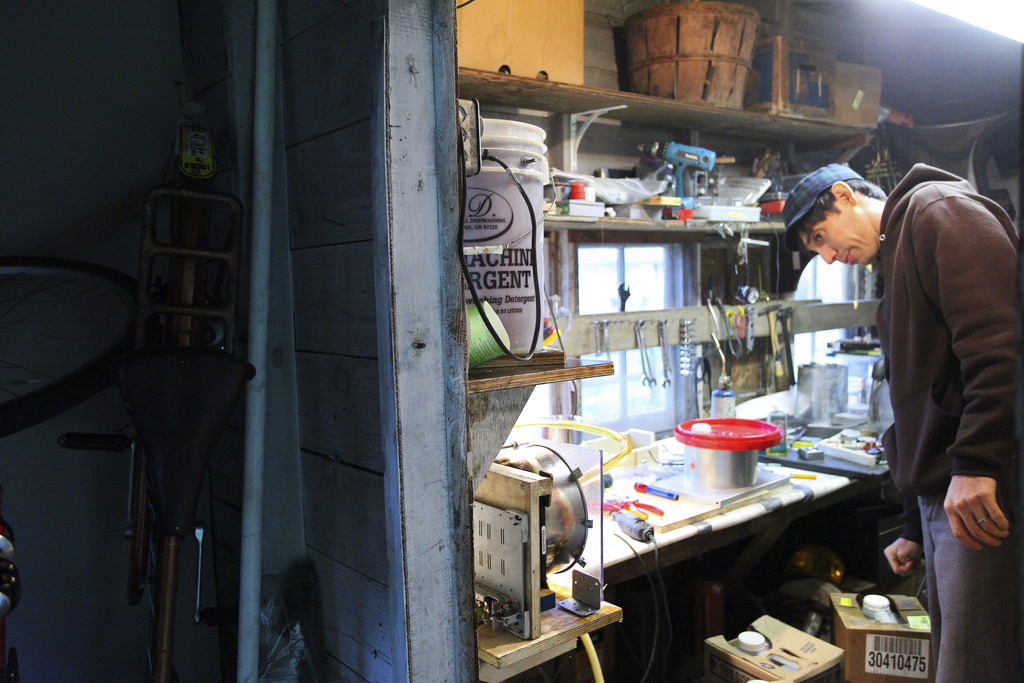
Long, slender hands, constantly moving.
Possibly his most mystifying attribute, however, is a curious sense of humor.
““Probably a false statement,” he says, nodding, indicating the message on the door”
Sitting on a sidewalk bench outside of Roots Organic Brewery, Santi wears yet another newly constructed hat, this one of tan cloth and long brim, shading his eyes from the hot sun. In his hand is a dinged up trumpet that he repaired and has been learning to play. He stares across the street, where there is an auto transmission shop with an accordion-style garage door. Painted on the door are the words SOUND HORN TO OPEN DOOR.
Pointing the trumpet at the door, Santi blows hard, sounding a splay of random notes with no particular pattern. Lowering the trumpet, he waits for a response. The door does not open. He sets the trumpet in his lap and sips beer. After a while, he nods toward the garage, saying, “I’ll try again—the door.” And puts the horn to his lips. The pub patrons at the surrounding benches glance at Santi, repeatedly, but quickly turn away. Unfazed by the attention, Santi blows again, this time calling out a single screeching note, loud and long. The trumpet blast echoes off the wall of the garage, reverberates crisply, and disappears.
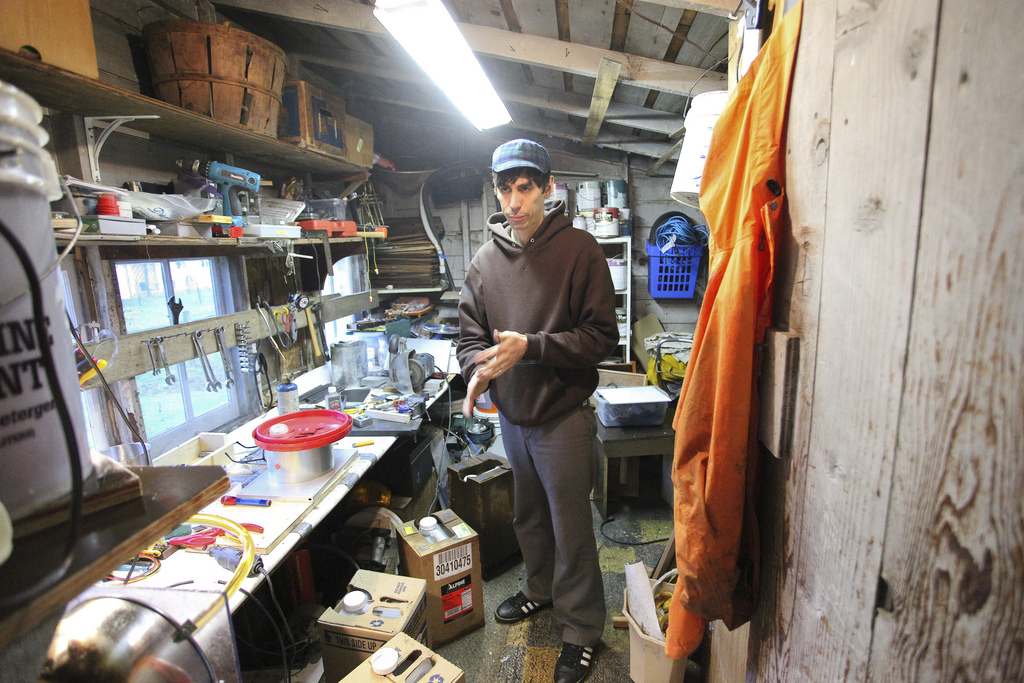
At home in the workshop.
After a long while of intermittent door testing, a number of beers, and a long conversation, Santi surrenders. “Probably a false statement,” he says, nodding, indicating the message on the door. He retires the trumpet to the tabletop, where it gleams, pock marked and greasy, in the sun. Not once during the trumpeting did Santi crack a smile. And he does not smile now.
But you easily could. And, looking up, you could just as easily wonder about the blue sky. About people. About radio… And its targets.
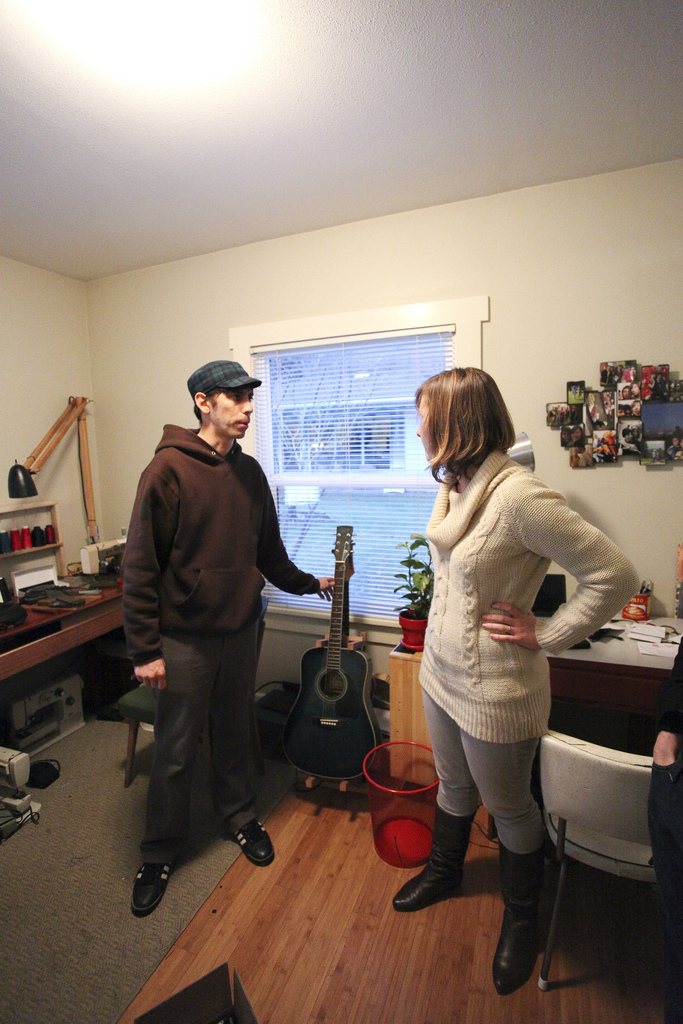
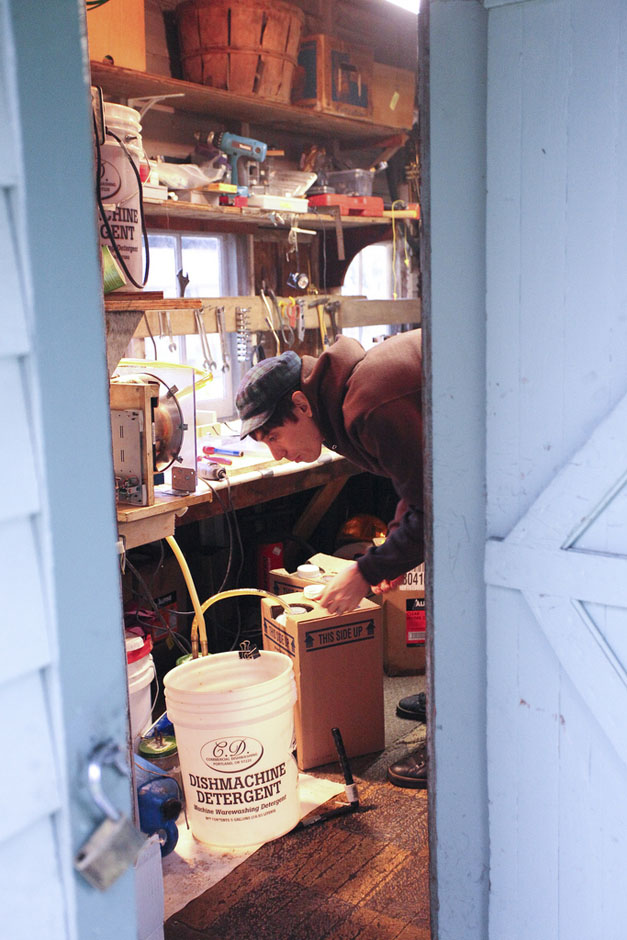
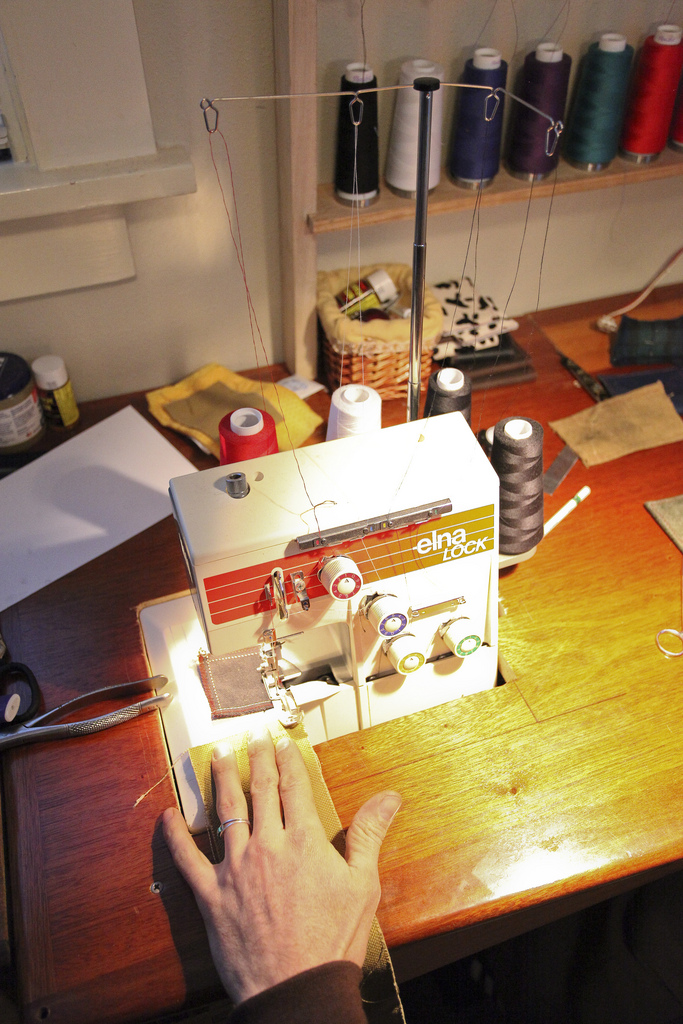
Click any image to view the gallery.