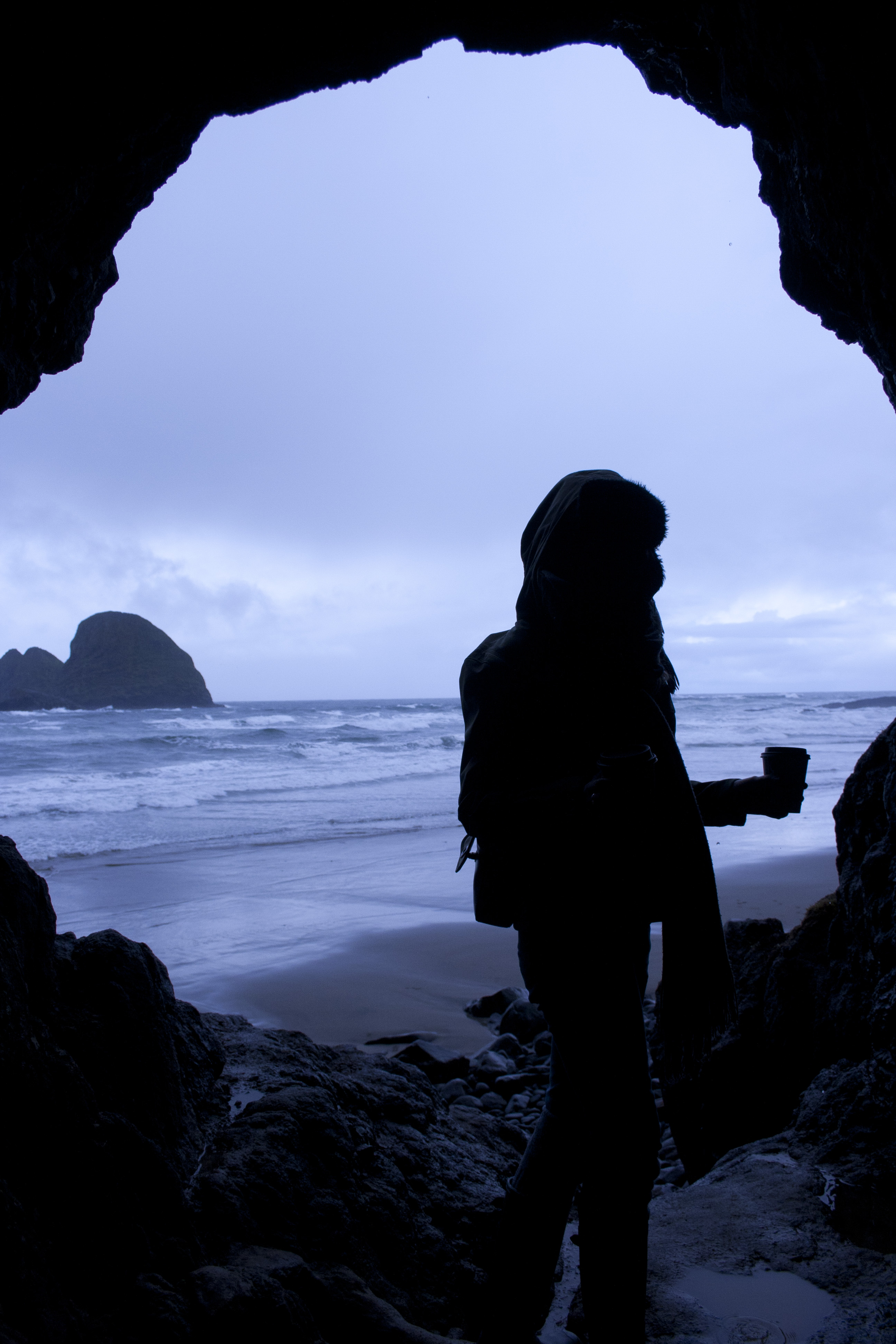
I was after something a little bigger. The beach is so much more than shells, starfish, and oversized rock. Scattered along the coastline were towns of people, the very people responsible for all that beach décor. No doubt, they would be steeped in very different kind of symbols. Symbols of their towns, their histories: life on the coastline. They were no starfish, these humans. What beach symbols representing themselves would we find? My intrepid research assistant, Anna, and I had chosen three different coastal towns that might hold clues. The towns were of differing character and industry—and overall vibe. Yet, they were all coastal towns, emblematic of life at the water’s edge.
.
weather permitting
The intermittent weather begins to turn surly.
The partial sun breaks and grey clouds become ardently dark, the air chilly and moist, the horizon over the ocean growing black, as we drive south, away from Astoria, where we may have stayed too long. Weather is something more than polite conversation in this locale, it’s part of the excitement, part of the disappointment. Part of the mood. Our next destination is known for a kind of sunny entertainment, a t-shirt-and-tan, penny arcade town. But, clearly, we will be seeing Seaside, Oregon in the rain.
Farmhouses, scattered cows, chickens, goats, and, every so often, a golf course, go sailing past, until we arrive at our destination. We park downtown and climb out. The streetlamps are in the shape of starfish, and, against the sky’s grey blanket, the sun is a solitary pinhole. Across the street is a sober mural honoring an immigrant population. It’s an inauspicious start to fun town, but a block later, after waving to a longhair cat in a display window, we cross over into a full-throttle city arcade. The earnest tone of the mural is behind us, swapped out for posters of board shorts, nail polish, and costume jewelry. The streets are lined with polychromatic shops and the sidewalks stirring with anxious people.
It begins to rain.
“To remember is to resist the silence that history imposes on the voiceless.”
Anna and I duck into a confectionary, where we discover, alongside taffy that can be bought by the bucketful and rows and rows of assorted sweets, displays of butter, chicken, lobster claw, and underpants suckers. It’s unclear to us just what mouthwatering delight comes labeled as “underpants.” After a moment of examination, however, hardly daring to pick up the box, we move along. Some things are best left to speculation. We steer around several kids, standing zombie-like in the isle, paralyzed by the overwhelming bounty, their parents stationed nearby, dutiful and compliant. We pause at the front door, which is stickered with brand logos from top to bottom. It’s strikingly similar to the sports endorsement you see on racing cars. But the association between the two remains foggy.
The rain slows and we hit the streets again, where the activity level remains constant, the weather be damned. Many adults can be seen with their hoods up and their heads down against the adversity. The kids carry on, hoods down, their hair wet.
As a color pallet, the look of downtown Seaside—the shop windows, cafés, signs, and game arcades—have much in common with the festive taffy available in the bulk bins. Everything is neatly coordinated, as if decorated by a tidy clown. Orange and green and red and yellow—eye catching, vibrant, gaudy swirls of sweetness line the street and shelves alike. And, as if not to be outdone, various motorcycles and cars parked along the curb also broadcast the same razzle-dazzle colors, designed to steal your attention. Everything proudly smacks of sugar, complete with marquee names like “Funland” and something called the “Center of The Elephant Ear Universe.” One need only imagine.
The Sea is alway changing.
welcome to the tiki hut
We continue our search for illumination. Walking Broadway, it’s cold, and I glance up into the sky, one eye squinting in suspicion, and the sky seems to sneer back. Arcades are a shuck, you know. A good-natured way to lighten your wallet. Yet, they strike me as oddly poignant. Which is peculiar, since arcades are constructed for quite the opposite reaction: as a relief from meaning.
All the same, I’m reminded of my enlightening introduction to the coastal amusement center. It happened on a daytrip to Asbury Park, where my mother had dropped off my younger brother and me to entertain ourselves. Unknowing boys of seven and nine, we were perusing the New Jersey boardwalk, when we happened upon a curious thing that stopped us cold. It was a ride at the edge of the park, both attractive and utterly incomprehensible to our young minds.

The ride was called the Tiki Hut. .
At that age, anything tiki themed brought to mind nothing more than a vague notion of bamboo wallpaper. Yet here, other than the a few stalks jutting from ride’s marquee, bamboo was nowhere in sight. Nor was there a hut, per se. Instead, what we beheld was a single, giant oil drum, painted blue, resting on a makeshift metal stand. A solitary pole ran through the top and held the drum aloft. How could we resist such mystery?
We paid with our allowance and ran to the drum.
The attendant opened the drum door, a crude hole cut by a blowtorch, and we stepped in. Inside we found a strange austerity. Suspended from the pole were a bench and a single light bulb, glowing red. And nothing else. We sat on the bench and the man closed the door.
A moment later the drum began to turn slowly around us. We waited for more, patient on our bench. But that was it. There was nothing more. We knew nothing of the make-out session this savvy amusement intended to inspire. Instead, in its place, we were treated to the sound of a handful of broken glass that lay roiling at our feet, a janitorial oversight. The glass shambled fitfully—cashka cashka cashka—as the drum rotated on the pole and the red light shone its beacon of love. All we could do was laugh.
My brother and I talked about the Tiki Hut for years, afterwards. Later, as grownups, we determined that the Tiki Hut was a premonition of romantic life. There is the mystery. The entrance ticket. The exploration. The red light. The inevitable sound of broken glass. And the realization that you have become trapped in nothing more than a spinning drum, broken glass roiling at your feet. Cashka cashka cashka.
And we thought it was just gonna be an amusement park ride.
Click any image to view the gallery.
a colorful carrousel
After wandering Broadway, weaving in and out between the determined revelers, cruising by storefronts hawking ceramic starfish, glass dolphins, and other beach retail, we enter an open pavilion and walk down a long hallway to the building’s center. The hallway terminates in full sized carrousel. And it’s a sight to see.
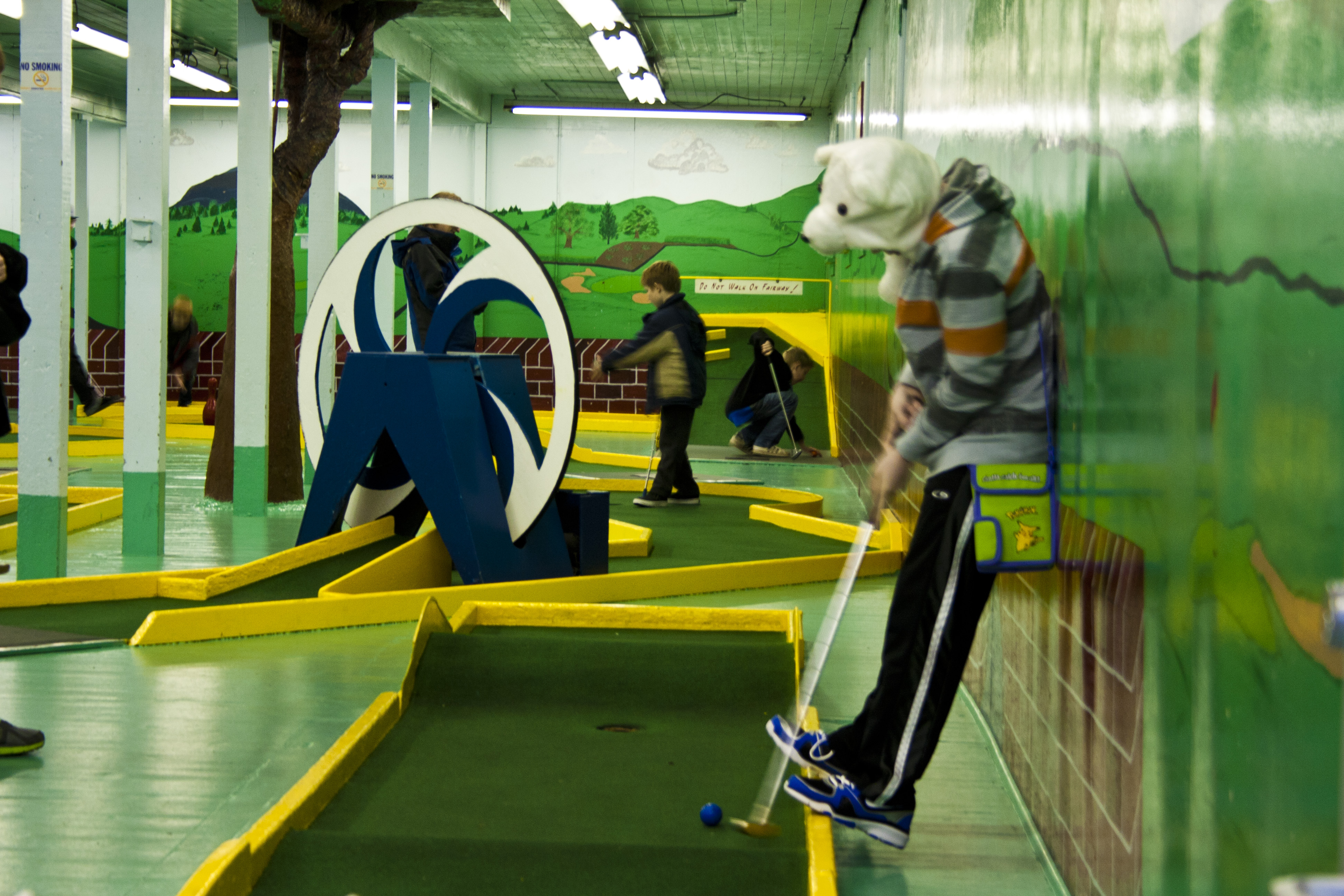
The carrousel is an onslaught of white and green and red and blue, with plates of mirror glass spinning above the base, and sea horses and cats and fish that go round and round and round, children straddling their back—a classic. It’s familiar to me. Once upon a time, I used to bring my daughter to the pavilion. She loved this brightly colored spectacle, which we often rode together. I confess it has been my favorite Seaside amusement. Though I once scored a near perfect game of miniature golf. And I can’t golf. That makes a guy happy, too.
Anna and I watch as the kids go round in circles, the colors whizzing by, and I’m contemplating what it means to grow up. See what I mean about amusements…..
candy, cigarettes, corndogs
After a visit to miniature golf, Tilt-A-Whirl, and bumper cars, it’s getting late and the hotel is a good distance off, so we opt to go. On our way back to the car, Anna stops me with a question.
“Do you smell that?”
I nod. That smell has been here since we arrived.
“Just what is it?”
I peer in the direction of the arcades and realize that Anna has totally nailed it. Seriously. I’ve not been paying attention. Amusement parks all have that same fragrance, from one end of the coast to the other. Just like the old cafeterias and lunch counters and department stores have their aromas. So what exactly is that smell, the aroma of amusement? We sniff the air. It’s not hard to identify. Candy. Cigarettes. I say. Corn dogs, she concludes. Love it or hate it, there it is. Like a wafting memory.

We climb into the car and pull into sparse traffic. It’s dark now, but the town shines brightly. On the way out of Seaside we pass rows of box stores, carefully situated on the other side of the highway, as if lying in wait. Box stores have no identifying aroma. That’s not what they’re about. But in this case, they do have a sea analogy. Like barnacles, they have attached themselves to a thing, and over time, demonstrate the tendency to cripple a vessel that once lured you to the sea.
The speed limit increases and we speed off.
“Memory is not solitary. It is choral.”
sexy lexy
We overnight in Netarts, a ways to the south, off the 101 and on a peninsula. At night, the peninsula is nearly lightless, frighteningly so for the city native. It’s times like this when, for city folk, you realize how much light pollution plays a role in your psyche. In your sense of security.
Our hotel dwells on a slight rise from the sea, on Crab Avenue. Looking out of the hotel room window, toward the water, nothing can be seen other than an impenetrable blackness, from which radiates a mighty roar. After peeking around the curtain at the dark for a few minutes, I give up. Overtop the bed I spy an arrangement of gold decorative gulls, affixed to the wall. We’re at the beach, after all. Over by the tv is a small stack of pulp fiction..
In the morning, I survey the coastline, the buildings, the sidewalks and streets, giving shape to the sounds of the night. The strip of beach, the entire distance from Netarts to Oceanside, is empty, as are the roads. For that matter, last night, so was the hotel desk when we arrived. It was a telling scene.
We rang the bell. In the other room could be heard soft voices speaking in a foreign tongue. For a time, we listened but were unable to identify the language. The proprietor appeared from the doorway and greeted us. The voices continued, hushed. The proprietor was tall man with a retiring manner, albeit no older than his mid-thirties. We asked about walking paths in the area. Providing rich and detailed descriptions of the trails and geography, while monosyllabic on all other matters, our host, in his answers, came across very much a part of the local landscape.
In contrast to Astoria and Seaside, this is the coastline of the solitary beach walk, the ruminating shore. The solitary individual.
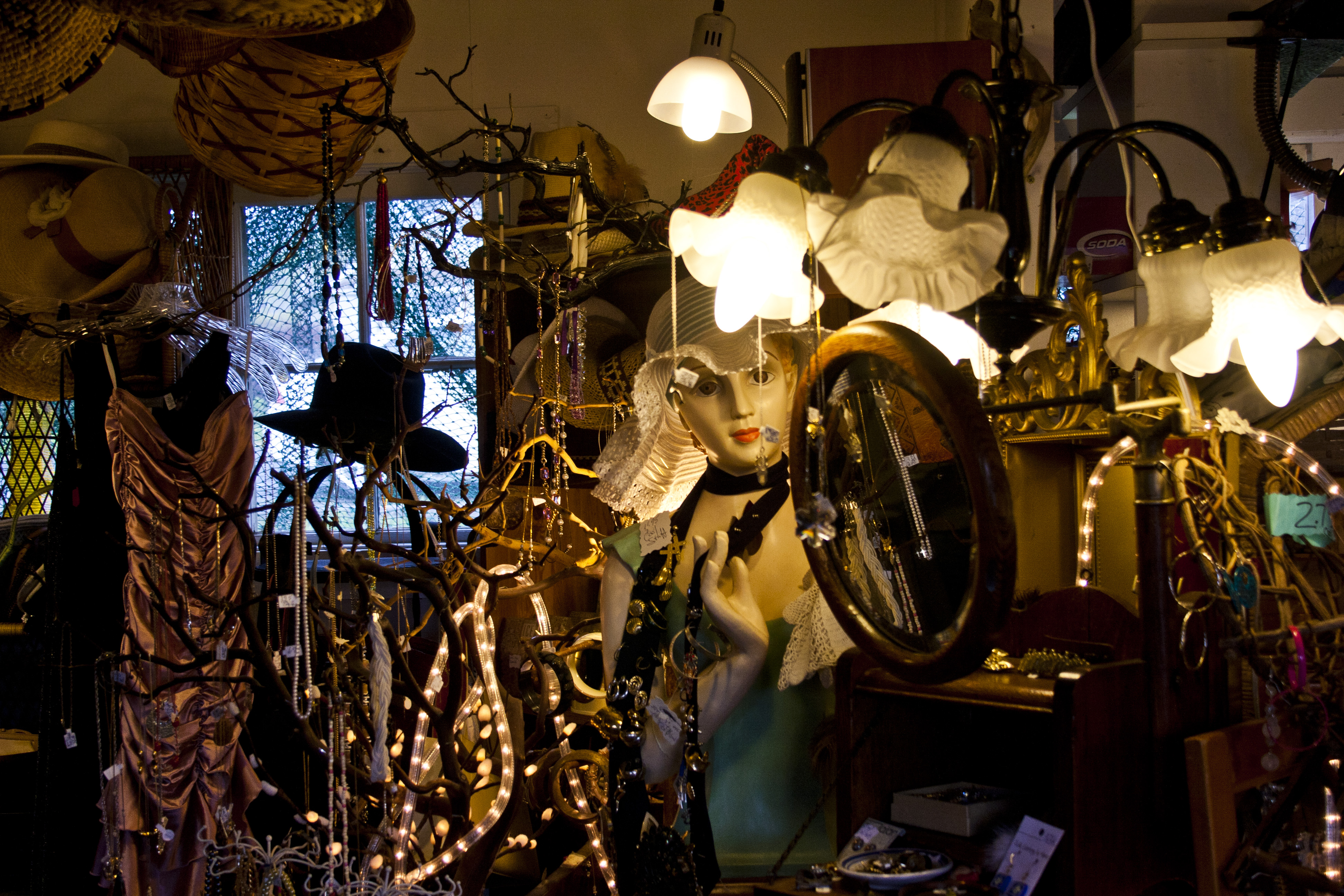
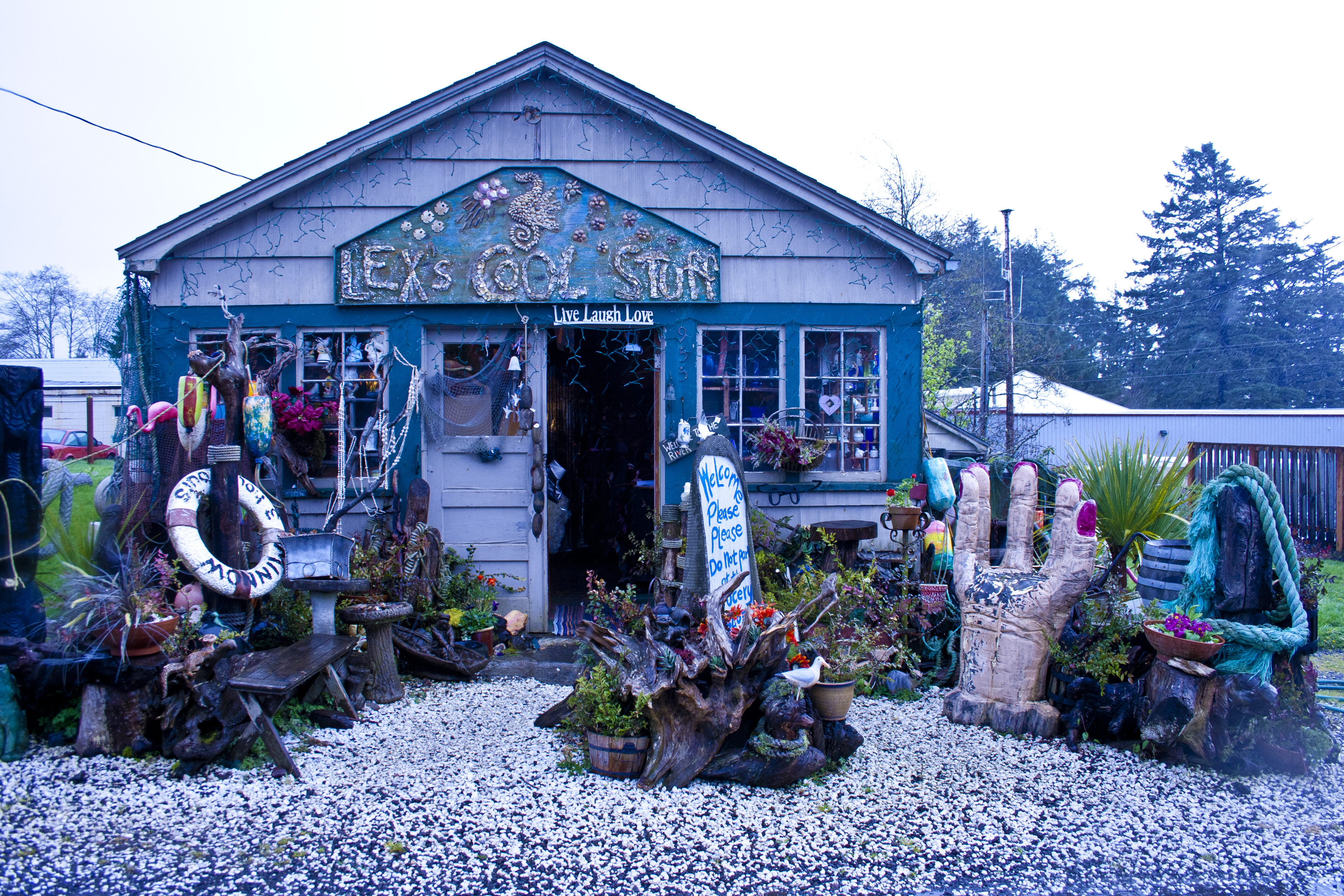
Before departing Crab Avenue, Anna and I stop at a place we had been eyeballing since our arrival. Lex’s Cool Stuff is a second-hand shop, decorated in the style of a beach fairy tale, an ideal site for an endearing indie film or best-selling novel, breezy and idiosyncratic. If you should ever have occasion to explain the Oregon Coast in a single image, you might be inclined to choose this fantastically decorated bungalow. It’s a life-size postcard.
The front door is open and we wander in. There are two rooms decked out from floor to ceiling with countless recycled treasures. Necklaces hung from tree branches, dresses of faded-glamour, western hats atop albino mannequins, woven baskets fixed to the ceiling, lamps, bracelets, mirrors, desks, dishes, forks and knives and spoons positioned everywhere. And a floor hand painted with giant flower petals. In fact, there appears to be everything in this store but the owner. No one is home. In place of the owner stands a table in the center of the room, upon which is proffered a tin box, its lid open. The box is half full with squares of brownies and bourbon balls. And, before the tin is a note, hastily scrawled by the owner. One “Sexy Lexy.”
Have some brownies—
Make yourselves at home—I love you— Be right back—
P.S. If you are in a hurry, there is change in the cigar box on my desk.
return to sender
We merge onto the 101 at Tillamook and head north toward our final destination. But I already know what we are going to find at Cannon Beach. Decades ago, while still living in Washington State, my family made trips to the Oregon Coast a family annual. Trips that were sponsored by an inexpensive rental in Manzanita, owned by a family friend, John. Cannon Beach was a jump north from Manzanita, and we often sojourned there for the bakery, prized by my father for their éclairs and sticky buns. Most of which left me feeling ill from the dosage.

That was a long time ago. But I still remember Cannon Beach as a funky coastal town, full of artists, full of characters. And a small contingent of lazy tourists. Squinting my eyes, I can almost see the women in peasant dress, the men in long hair and scruffy jeans. The sparely populated streets. The kooky art galleries. No one was in a hurry. The coast can be a difficult place to make a go of it, unless you are of independent means. As a girl, Anna and her mother lived in Cannon Beach. For a year, they barely scraped by. If appearances are telling, however, the tourist trade has been good to Cannon Beach, at least since our early hauntings. /pre>

	  Opening my eyes wider, I picture today’s town. The rows of businesses with their aging cedar and paint cracking clapboard have mostly been upgraded to new cedar and fresh paint. The newness is still punctuated by ultra-white shops vending saltwater taffy and ice cream of yore. But their paint is fresh, too. I’m likewise pleased that the same fish n’ chips joint from once upon a time is extant, though the interior has since been souped-up with wall art depicting fish, fishing, and a fish market. (Yes, indeed, the place is also a fish market.) There are newer pubs, as well, with their own micro brew and glass-blown taps, crafted by locals. The coffee houses have their own brand of roast. In the five-by-ten blocks that comprise downtown, there are more than six or more art galleries, a number of wine tasting shops, multiple clothes merchants, and an excess of blown glass in myriad window dressings and gallery settings. The beach here is one of the most beautiful on a coastline of gorgeous beaches, a long stretch of flat sand and a shoreline punctuated by great sculptured rock, protruding from both water and cliff.
The patient, it would seem, is in excellent health.

what’s my line
It occurs to me that each of these towns we’ve visited retains a strong sense of a distinctive, earlier era. And that each also represents a particular idea of what it means to be a coastal town. Astoria is the turn-of-the-last-century port city. Its ideal is utility. The ocean as something useful, as industry. Seaside is the 1940s ocean side amusement park. Its ideal is the get-away. The ocean as a playground myth. Cannon Beach is ‘70s counter culture. Its ideal is the vibe. The ocean as natural beauty.
My eyes are wide open now. We’ve come along way from forty-one beach symbols in six hundred square feet.

returning symbols
There is a store in Seaside where you can purchase any number of beach emblem, beach tchotchke, beach sign, beach paraphernalia. That’s all they sell. Any of the items, it seems, that can be found in your beach rental are available for purchase. Someone has discerned a market. No longer does the experience of non-stop beach symbols must needs be predicated on the length of your stay. You can bring home—beach takeout!—the countless reminders of the beach that overrun every beach cabin. And, while in the comfort of your own home, you can recall that once you were at the beach.
Here’s where it gets tricky. I’ve put a lot of thought into these symbols, this phenomena, since my original accounting. And I’ve finally figured something out. All these beach symbols are a welcome mat, writ large. A decorative way of introducing guests to the local scene. It’s a way of saying: this is what we eat. This is how we live. This is what we value. It’s a friendly introduction. Yet, it is also something more complicated.
You see, on the other hand, a beach guest can easily find a painting of a crab in your rental or café or pub, wherever. But nowhere will you find a guide to the crab at home in its tide pool, or any information detailing the local flora and fauna, the other area residents. (Other than in a few bookstores.) The absence of guidebooks makes the painting’s presence suspiciously like an inducement to dine on crab. If you catch my drift. An advertisement. The gesture, it turns out, is both a welcome and a sales pitch.

Earlier this year, on a stay near Lincoln City, I was forced into the auto parts store, when my windshield wiper broke. An aging gentleman with a gruff demeanor manned its counter, clearly a local from the way he spoke to friends who came in. Not that he was unfriendly, but after I took an interest in a photograph of a classic car that lived beneath the glass counter top, his tone change from night to day.
That car, a ‘67 Dodge Cornet, he had rebuilt and dedicated to his deceased wife. It was a beautiful automobile and I told him so. Next thing I knew Pat was ringing up the special “family” discount on that wiper blade. I saved five bucks. The night before, I’d given my waiter a buck with my name written on it, which he proceeded to wrap up with a tack and a quarter and toss elegantly at the fourteen-foot cedar ceiling, where it stuck. The ceiling was covered with dollars, donations each and every one, supporting the local high school.
Both experiences reminded me of the obvious: that there are the people who live on the coast. And they have lives quite without the tourist. And lives that include the tourist. They have the welcome mat. They have the sales pitch.
exit
Anna and I are heading north, closing in on Cannon Beach. It’s a beautiful day. Though the weather is unlikely to last, we are feeling well. There is something about the Oregon coast that improves the mood, even after a short stay. As I blaze along the 101, snaking this way