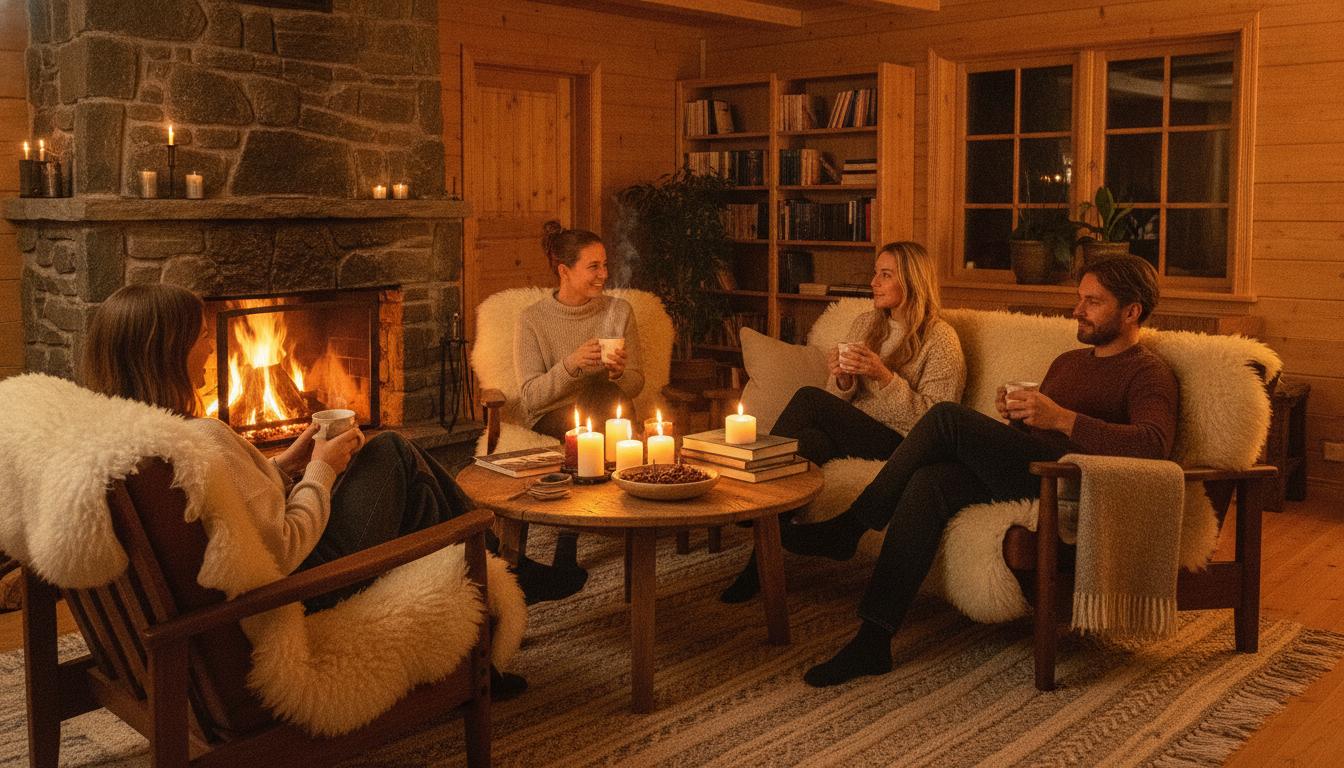
Lucky bastard. I was staying in a beachside cabin, cliff side, overlooking the sparkling ocean. And the weather was fantastic. The sun shone like a woman’s smile. Yet, I was troubled by something, something that had been niggling me for decades, whenever I visited the coast. The cabin was a small space, intimate, two closet sized bedrooms and one larger area that stands in for kitchen and dining and living room. In total, maybe all of six hundred square feet. And trimming out that limited space were an unrelenting number of beach decorations, beach paraphernalia, beach pictures. Indeed, all manner of beach symbols. Positioned everywhere.
In a manner of speaking, that was the sand in my shell. From the moment I strolled into the cabin and glanced around, I was in engaged in one constant reminder after another that… ah, well…. That I was at the beach! Surprise! The thing is, I know that I’m at the beach. After all, arriving there was no accident. Indeed, forgetting that I was at the beach would require a blunt trauma.
Beach terror!.
This is all more than forgivable. If it weren’t for the fact that every beach rental I’d ever stayed in—and I mean every one, and I’ve been visiting the Oregon coast for over three decades—was identically decorated, without respite. Take a shower. Watch the water splash off shower tile festooned with a creamy stripe of oversized starfish, conch shell, and sand dollar. Use the toilet. Find yourself staring down a wide-mouth ceramic fish, stuffed with rosy potpourri. Eat a meal. The shelves at the dining table brim with dried starfish, ocean shells and sand dollars, punctuated by a grandfather’s ode to a beach chair. Every activity comes prefixed with the word “beach.” Beach shower. Beach toilet. Beach dinner. Try to escape to the couch and find yourself surrounded by photos and illustrations of the beach. Beach chillin’. Go for a beer and check out the refrigerator magnets. All beach scenes. Save for the tsunami evacuation warning. Which is arguably a beach scene. Beach terror!
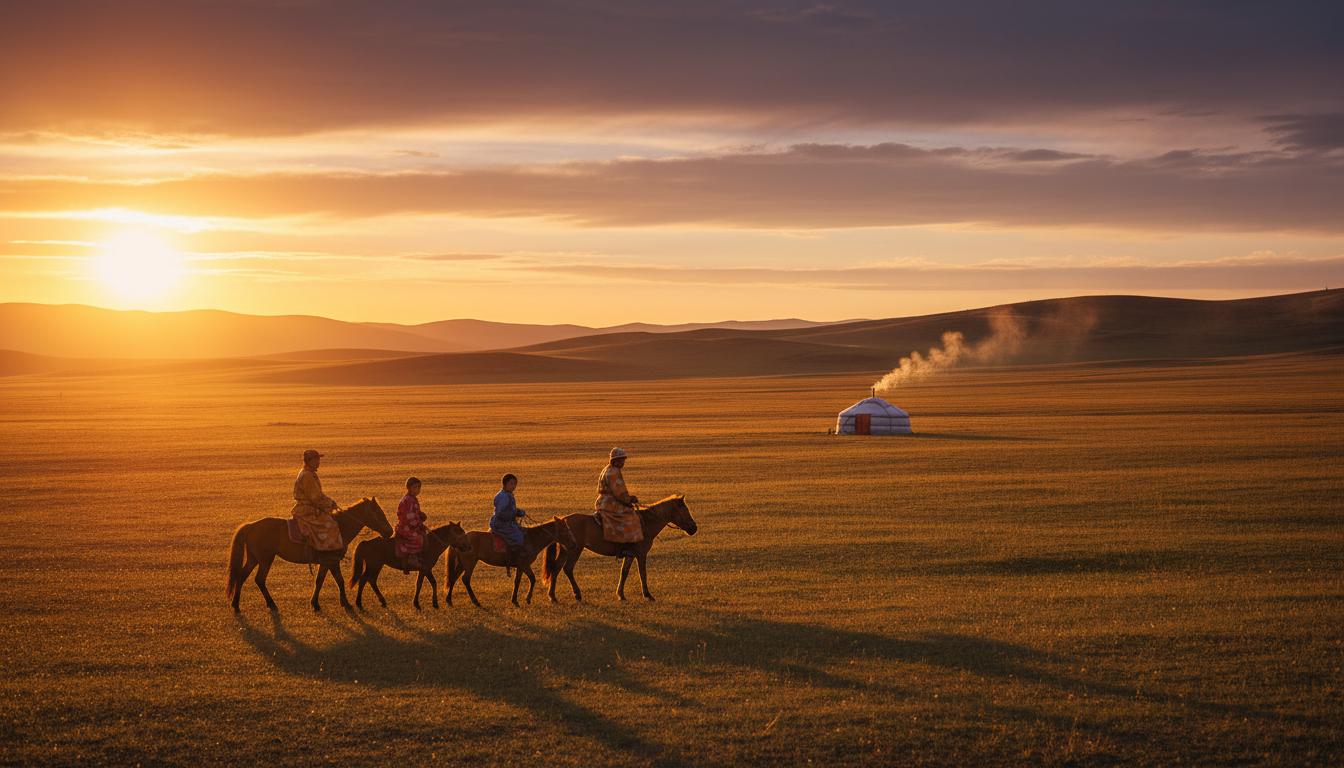
“The steppe does not belong to us. We belong to the steppe. It was here long before my grandfather's grandfather, and it will be here long after my grandchildren's children are gone.”
It defies explanation, this décor. There’s no mystery to it, of course: the beach décor is just there, right there on the wall. It’s just absolutely everywhere, up and down the coast. But that’s also the mystery. There’s almost no place you can go where the décor is different. Ask anyone to explain this phenomenon, and people look this way and that, mouth hanging open, awaiting the simple answer that doesn’t come. But here’s the kicker. I’m standing in this cabin, one of a long line of annual rentals, surrounded by said décor, when all the while a tilt of my head toward the windows reveals something genuinely spectacular. Yes. It’s the beach!
THE MISEEN ABYME THING
Despite the over salting of my visit (beach visit!), I was ready and willing to retire these thoughts, once again—and simply enjoy being ocean side. And I would have done so, if it weren’t for Haystack Rock.

Since my arrival, the following curiosities I’d already taken in. In the cabin’s living room was an illustration of the cabin itself, its perspective from across the street. There was a wide-angle photograph of the self-same street in winter snow (a fresh perspective). There were historic photographs with cars parked on the very beach above which we were so majestically perched. But it was during dinner preparations that I saw photographs that launched me into a certain frame of mind, from which it would be difficult to escape.
I had taken up station at the kitchen sink, where I found myself face to face with two framed pictures of Haystack Rock, the unofficial symbol of the Oregon Coast, a favorite of picture postcards, key chains, artist’s renderings, and tourist brochures. Standing there, the kitchen worker is indentured to these photos; there’s nowhere else to look but out the tiny kitchen window and onto the passing road, possibly to consider the perspective put forth in the living room photo. Preparing food, I had been eyeballing the two photos, when something occurred to me. Spinning on my heel, I swung round a half-turn to face the picture windows, which opened to the ocean vista, to the air and the horizon. To the sandy beach. And there it was. Haystack Rock. The one and only, the de facto rock—a thousand times bigger, huge and looming, bathed in gradually changing sunlight, teeming with life, birds darting, dashing, and diving in a dusty halo, limpid tide pools at its foot, wave after wave bursting against her sides. Right. Outside. The. Window.
Over dinner, I shared my observations—okay, obsession—with the two other guests. I attempted to gussy up the story. The décor is like a mise en abyme, I said, the same image reflected in another image, reflected in another, in another, in another. Growing smaller or larger, like nesting dolls. My companions were kind and interested, but only mildly so. It was obvious that I hadn’t been entirely persuasive. In my hyperbolic imagination, it felt like one of those movie moments, when the Jurassic paleontologist informs his companions that he’s discovered a nest of live dinosaur eggs, and his companions respond by questioning the sanity of discussing breakfast food. But never mind. Given the relaxed surroundings and the purpose of our trip—a birthday celebration—my story may have come across as inappropriately anxious and off topic. No argument there. Indeed, I resolved to calm myself. There were more befitting matters to consider.
My resolve was short lived. After a bit, on my way to the bathroom, I encountered Haystack Rock once again. This time in several smaller framed photos, tacked neatly onto the wall outside the bedroom. One of my companions pointed them out for my benefit. Thanks to those photographs, I took the image of Haystack Rock with me to the toilet. All the while, just outside and down the dry, grassy hill, mysteriously, the rock itself was hazy in the evenfall, high tide crashing about its sturdy base.
Okay, now I was genuinely bothered, my fuse gently tripped.  Now—I was on the case.
TCHOTCHKE COUNTING

The dishes were long done and my companions were having a lively conversation. But they were likewise keeping an eye trained on me. A perfectly reasonable thing to do, because what they are watching is a man, notebook in hand, briskly crisscrossing from wall to wall, doorway to doorway, room to room, appearing purposeful, while no sane purpose can be immediately gleaned. Curiosity gets the best of them, and they have to ask.
What are you doing?
Counting tchotchkes. Beach tchotchkes. There’s a ton of it. Once you start looking, it’s everywhere.
They glanced around the cabin and watch my undaunted progress. I’d not stopped to chat, which seems to lend authority to my otherwise eccentric activity. Possibly because it now looked more like a scavenger hunt than an abstract lecture from the pulpit of the weird, I’d piqued the better part of their interest. Though we took a break to walk the dusky beach, by mid-evening, I’d completed my informal survey.
“Forty-one beach symbols,” I announced. In six hundred square feet.
From that moment on, for the remainder of the trip, my companions took delight in this new trophy game. They found non-stop examples, and with each discovery, called them out loud. Early on, T. came to us with a small sea terrarium. “Look at this,” she exclaimed, presenting it to us, individually, affording a close-up look at a strange arrangement of diminutive beach items. (After which, she hid the thing in the hallway tack room.) Adding her own contribution, A. gleefully directed our attention all about the cabin. Strewn here and there were pillows (six by my count), displaying hand-painted shells and sea grass, along with matching bedspreads, themed in red and cream seaweed.
Tongue flashing forward ... "Scraps! Scraps! Scraps!"
We were in the cabin dining area, when a gull touched down on the outside porch railing. Which was kind of exciting, it was such a bold move. So close at hand, the creature stared at us, and turned one black eye toward the cabin interior for a better look-see. Having moved to the open porch door for a clearer view, I stared back. The bird didn’t budge but appeared to be waiting for something. The stance of the gull, perched stoically on the railing, immediately reminded me of all the statues of gulls that you see, ceramic birds standing on logs and railings, decorating the lawns and businesses and towns up and down the coast. Like so many other beach symbols, it was everywhere. The gull statuary exists to remind us of the gulls, however, not the other way around. No, no. But here was the actual gull calling to mind a statue, its imitation.
All of a sudden, the bird splayed open its beak, tongue flashing forward, and it clamorously cried out. Scraps! Scraps! Scraps!
Scraps…
BEACH COMBING OF A DIFFERENT SORT
It was high time for an adventure. Beach culture was clearly something lost on me. And all this thinking about beach decor and what might lie behind it cried out for a grab-your-beach-towel-and-sun-hat kind of field research. Get out of the house; get your hands dirty, as it were. (Ahem.) But this particular trip would be over too quickly for meaningful note taking. Research would have to take place later. So, I returned home, and after a bit of planning, boomeranged back to the beach a month later.
By now, I was after something a little bigger. The beach is so much more than shells, starfish, and oversized rock. Scattered along the coastline were towns of people, the very people who produced all that beach décor. No doubt, they would be steeped in very different kind of symbols. Symbols of their towns, their histories; life on the coastline. They were no starfish, these humans. What beach symbols representing themselves would we find? My intrepid research assistant, Anna, and I had chosen three different coastal towns that might hold clues. The towns were of differing character and industry—and overall vibe. Yet, they were all coastal towns, emblematic of life at the water’s edge.
Rather than scour the beach for shells, we would scour our towns for symbols, any kind of beach symbol, and see what they pointed to. In short, we were going beach combing. Beach combing of a different sort. Perfect.
We roll into Astoria. Stop number one. Gigantic red and white crane ships cruise the impressive Columbia River, white-capped and boldly blue and racing madly, as wide as any lake requiring ferry passage. Here, the grand ocean meets the great river. Here, was an estuary of water and people. Here, was to be found a beach town with absolutely no swimming. For this is Astoria, Oregon, where the water currents, roiling like the mind of god, keep compact with death. And you best pay heed.
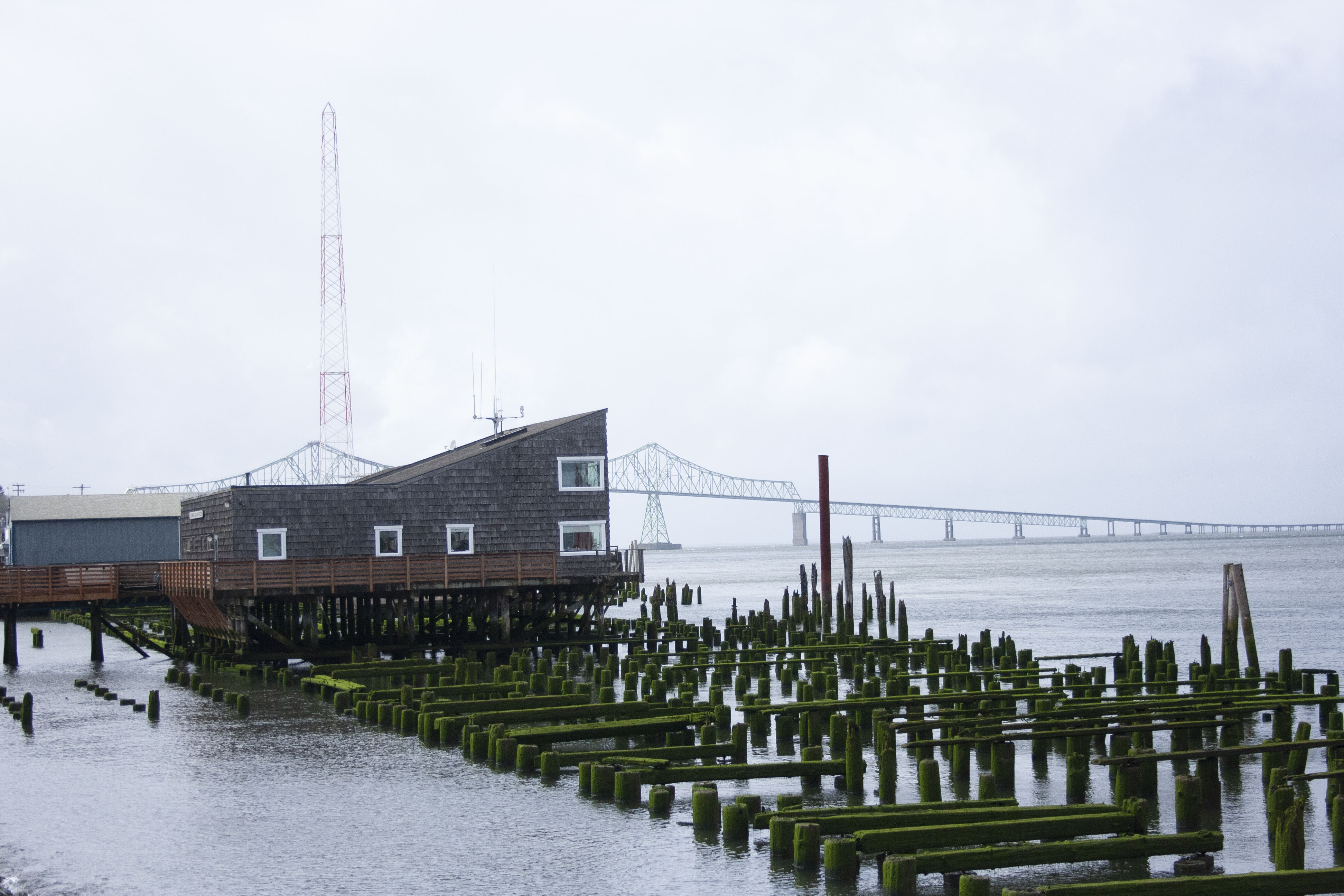
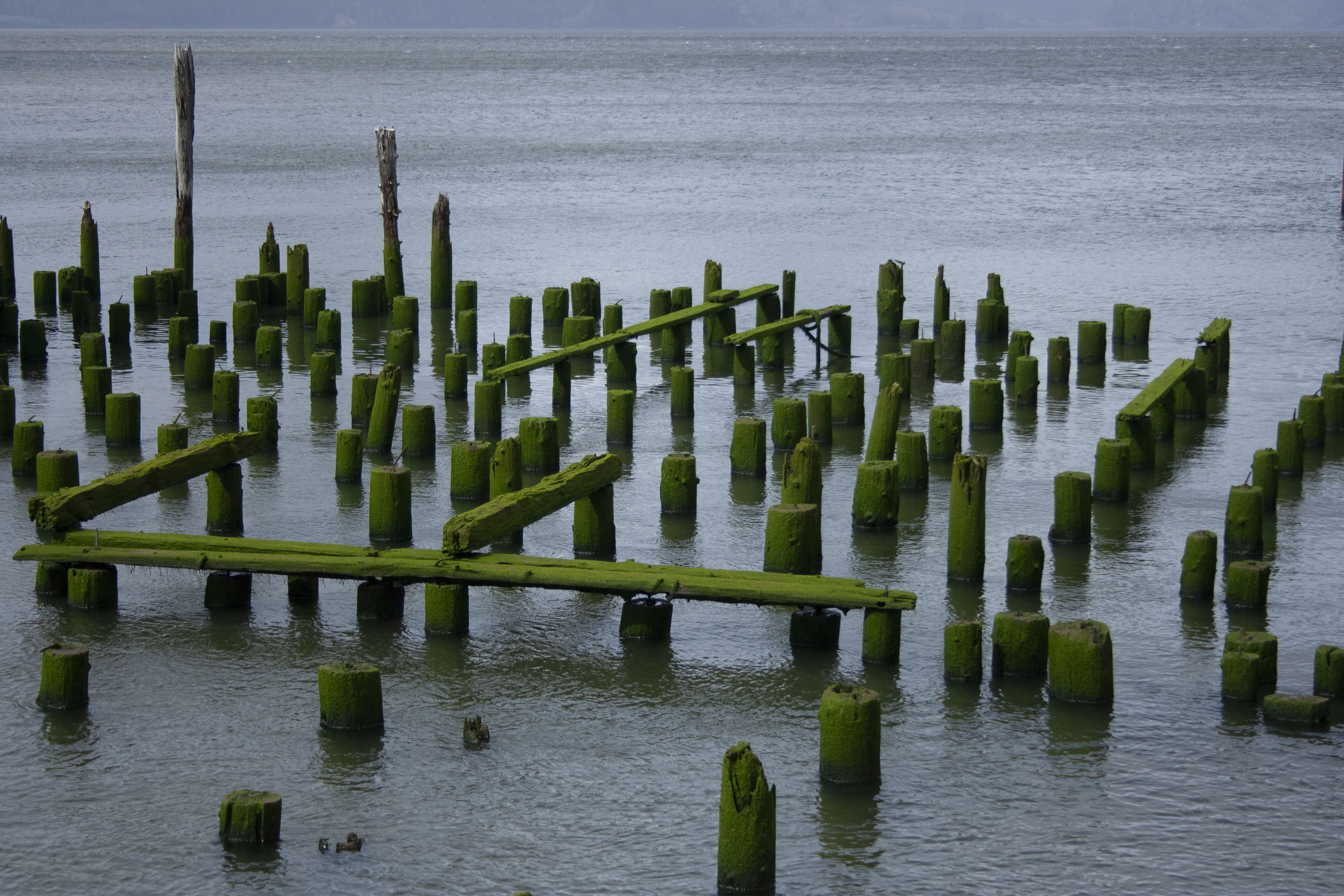
This is a town with history. It’s a variety of classic Pacific Northwest chronicle, one that taps many of the historic meat and potatoes of the region: the Lewis and Clark expedition, fur trading lore, refurbished log forts, clapboard houses baring their widow’s peak. A zenith of canning, timber and railroad shaped this town, as did their eventual eventide. The disappearance of which now shapes the town’s nadir. It is difficult to forget that Astoria has history. For the town itself romances its history, quite in spite of the jilting by multiple industries, both as a means of town identity, as well as out of necessity. After all, everyone needs something to sell. There’s a museum, plaques on buildings, and a hillside full of preservation homes. Further adding to the historic vibe, Astoria also has the feel of a place where various moments in time have been frozen, and continue to be on display. Bits of ancient and moss ridden pier stumps protrude from the river. They rub shoulders with new cedar shake offices and restaurants and older fishing and canning warehouses, all of which provides the foreground to the angular web of steel radio tower and symmetrical bridge that own the horizon line.
BOWPICKER, VICE COUNCILS, AND STRUMPETS
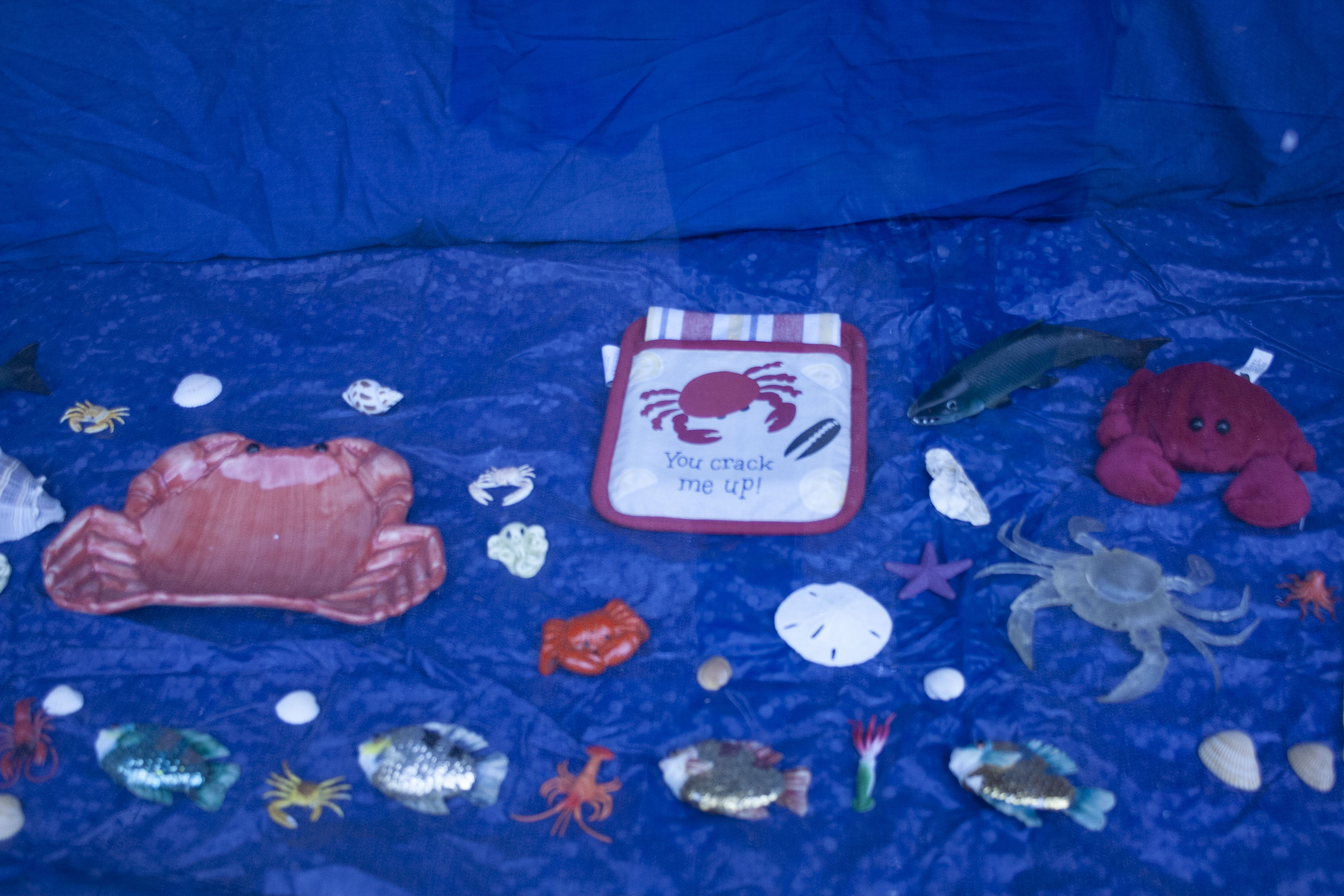
On a tight schedule, we skip the log cabin lore and the nautical museum. Instead, we opt for unearthing the bones of Astoria in more prosaic fair, marking our itinerary with fish and chips from a beached wooden boat and a ride up the residential hills, where so many houses are older, many old enough for historic registry. First, however, we score coffee, downtown. It’s downtown where we come across a doorway painted entirely, top to bottom, as a happy fish about to be grilled. We are also treated to a sidewalk trashcan rendered in the exact likeness of canned salmon, reading: “Gill Netters Best, Columbia River, Spring Catch, Royal Chinook Salmon, Packed by Salmon fishermen Cooperative Packing Company, Astoria Oregon.” Lastly, there is an entertaining window display crowded with Beanie Baby lobsters, plastic fish, actual sea shells, and an oven mitt printed with a smiling red crab who had this to say. “You crack me up.”
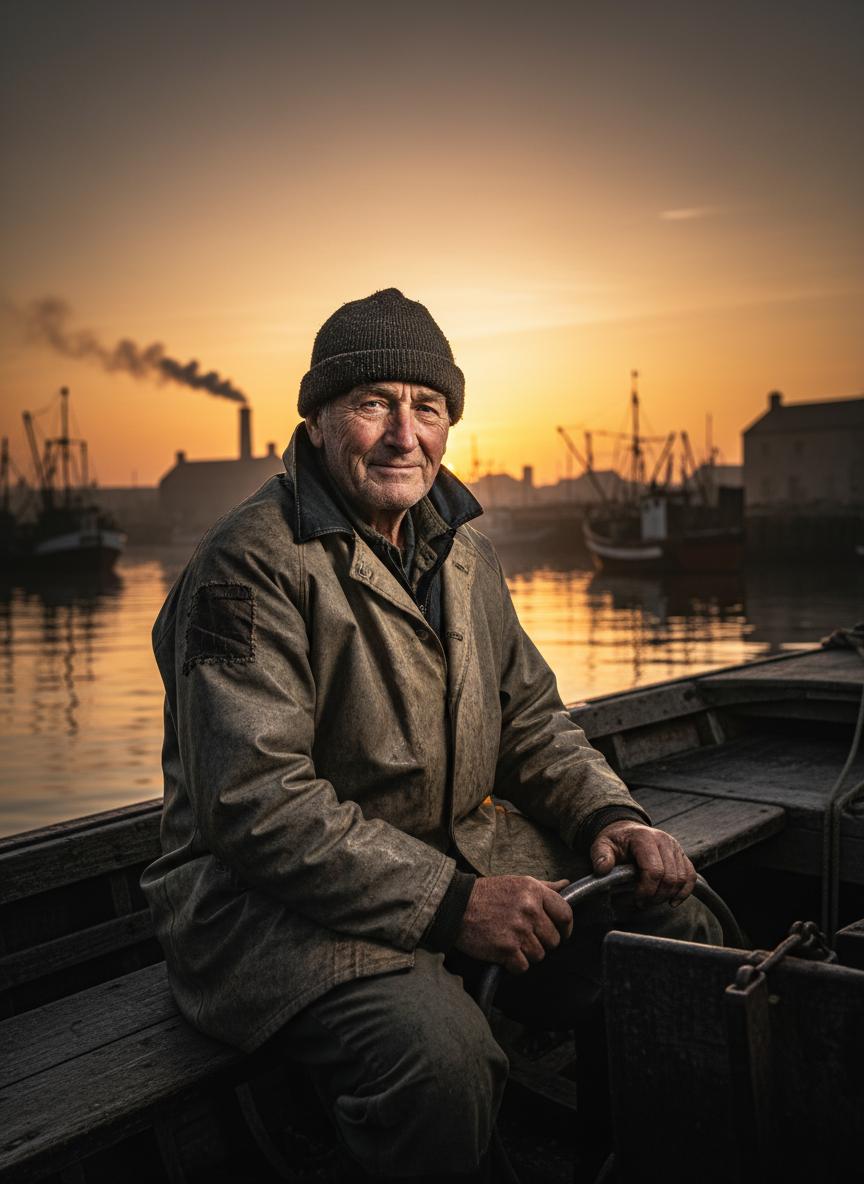
By this time we are full-on hungry, and seek out the Bowpicker. Bowpicking was a longstanding gillnet fishing method, a way to put bread on the table in the nineteenth century, a fishing tradition once common to the river. We found the Bowpicker beached on a small side street, a solitary small craft, red and white, nearby the Custard King and directly across from the mildew stained Moose Lodge. Whereas once those aboard a bowpicker would have picked fish from the net, now the two women of the Bowpicker pick fish from a sealed brown paper bag, dropping the breaded fish straight from the bag to the smoking deep fat.
“11ish to 6ish ... weather permitting.”

Even on this cool and cloudy day, there is a line, and we get in it. When it begins to rain on those of us in line, one of the cooks calls out through the glass-absent window of the smoking wheelhouse, offering, in the most informal of shout-outs, umbrellas to folks in the queue. “No, thanks. We’re fine.” Everyone sticks it out and the rain shortly subsides. When we arrive at the ordering window, I notice that to our right is a chalk sign informing patrons that the hours, although “11ish to 6ish,” are “weather permitting.” The words, scrawled in chalk, have been smeared by rainwater. It seems that a certain flexibility and gusto, less common to inland city dwelling, is a required of the locals—and applies equally to out-of-town guests.
Anna and I collect lunch and sit underneath a leafless tree, on a damp bench, and eat our fish. While it might be considered apocryphal to the chamber of commerce, fish n chips from a beached bowpicker, too, is local history unfolding. It didn’t exactly come with a plaque, but the story is easy enough to read, right there on the gravel sidewalk. And it tastes pretty good.
BARREL CHESTED MANSION
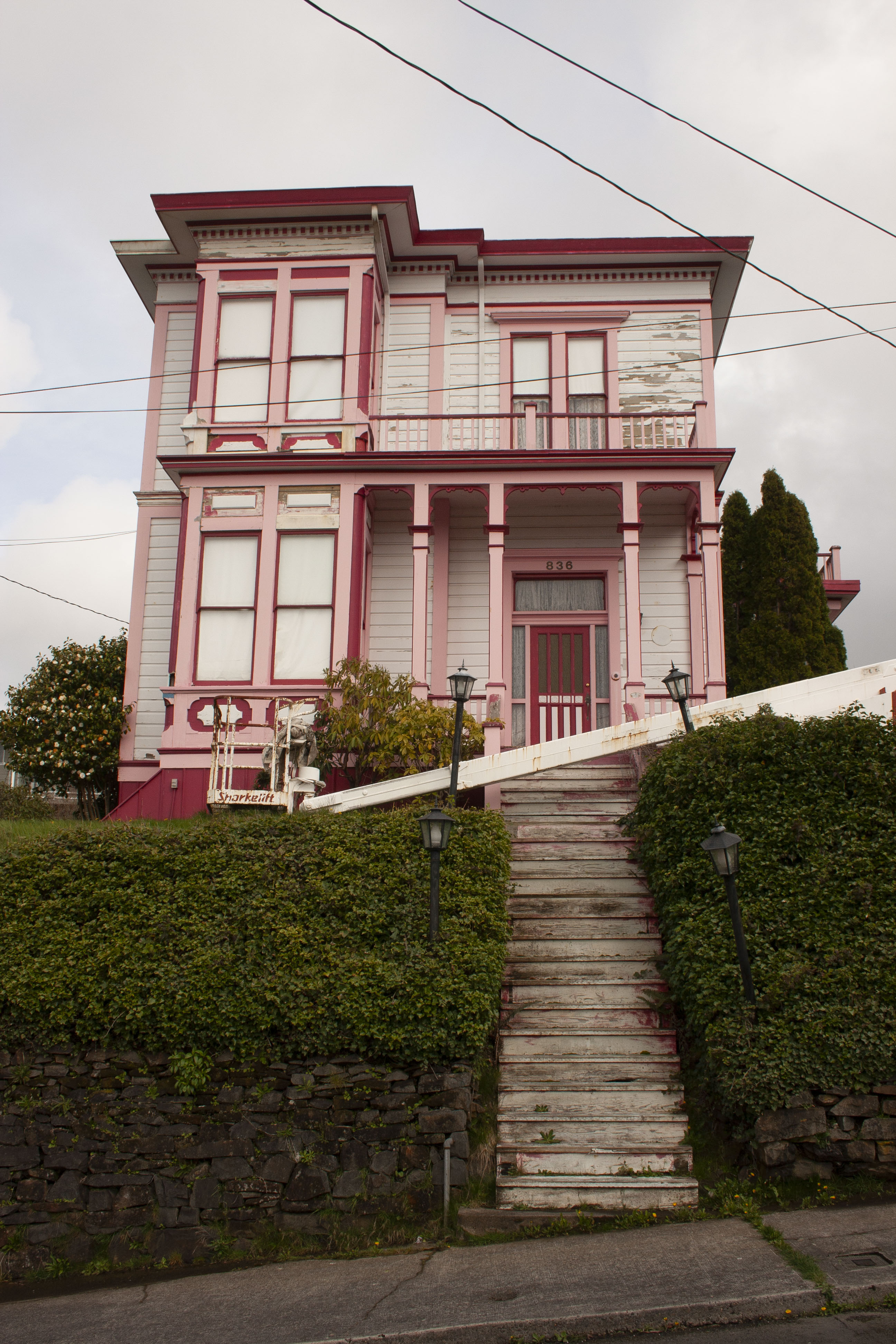
Astoria gives the strong impression of a place dusty and threadbare, with a patina of long-suffering, shy romance. An aging coquette with a struggling roadside motel. And the most romantic place in town might be what lies up the hill, the world outside the obviousness of downtown, with its port, museums, and industry. The hill of residential homes, a solid slope of clapboard houses, peppered with aging churches, and made dizzy by a winning river vista, watches over the port and town like some droopy-eyed and retiring lightkeeper, an old salt still around to see it change all over again. Halfway up, we stumble upon a boarded up mansion, next to a row of colorful homes of matching design and historic registry, a plaque on every facade. It’s too good to resist, and we stop.
After parking, we walk excitedly toward the mansion. We pass a porch, the last house before the mansion’s unkempt grounds. Just then, an elderly woman wearing an oversized yellow terrycloth robe ambles out onto the porch, accompanied by a lame dog, favoring one leg, his eyesight questionable, his blue eyes clouded. Splaying his legs slightly outward, steadying himself on all fours before beginning, the dog barks.
“Sorry about that,” calls the woman, entirely unself-conscious about the time of day—it’s four in the afternoon and she’s not yet out of her robe. We slow down but she addresses us only minimally. Her tone is husky and matter-of-fact. “He’s just saying Hi,” she says of the dog. It certainly is friendly. I mean, the whole scene. I suspect that this is also just her way of saying Hi. The robe, the porch, the dog.
We smile, but the woman is not looking for a response. It’s her porch and she simply getting some air. We continue on, climbing the stairs to the mansion. The building is set back from the street, farther than any of the other homes. The lot, grass and all, overtakes the block’s end cap, stretching from one intersection to the next, with the house sat squarely in the center, seriously owning the lot. Even with the doors and windows boarded, and the black smeared clapboard, its paint in places long since worn off and punished by ages of weather, the mansion still presents itself, barrel chested, with lionhearted assurance.
Walking back to the car, we meet Ron. His wife has disappeared inside with the dog, without a trace. In the doorway now stands the tabby cat named Stormy. Ron is out strolling the sidewalk. This row of houses, he informs us, his house included, were designed, built, and belonged to a French Vice Council, of local yore. The Vice Council was also responsible for some of Astoria’s shanghai bars and houses of ill-repute, hijackings and strumpets. Ron leavens this tattle, leaning towards us and saying, “I don’t know what a Vice Council was doing that for!”
The mansion belonged to a former mayor, Ron continues, shaking his head, slowly. The mayor’s son inherited the place but ended up with jail time. Since his release, the son has not been seen nor heard from. The city is in a quandary as to how to get its hand on this beauty before it’s all gone. Recently, they dispatched carpenters to board up the windows and doors. I glance back at the mansion for a second consideration. It seems a manful, a thing belligerent about being painted into the new order. Unlike many of the historic homes on the hill, which have welcome helpings of fresh paint.
But things are kinda going.
Regarding his own house, Ron quips. “Both of us aren’t in great condition.”
Then, looking as if maybe he’s said too much—illicit French Vice Councils, jailbird neighbors, et al—Ron excuses himself from the conversation and starts up the stairs.
“It’s not that it’s a happening town, “he says, by way of explanation, or some sort of apology. “But things are kinda going.
RISING AND FALLING
On the way out of town, down the 101, we pass the four-mile long, theatrical spectacle that is the Astoria-Megler Bridge. The bridge spans the river from one side to the other, Washington to Oregon, skimming the water’s surface for three-quarters of the distance, along which gulls race up and down on the air currents, sailing parallel to the traffic lanes, until, at the last quarter distance, the bridge swiftly rises up to a dizzying height, its arched spine affording unfettered passage by the red and white ships sailing underneath its lift. This enormous metal truss and concrete structure speaks volumes about Astoria.
As a pure sight, the bridge is an industrial poem of human achievement, an exemplary throughput for automobiles, encouraging drivers to shoot past and get on down the road. It is likewise a figurative slap in the face to the town on its south-side touchdown. Racing across the bridge, one gets the idea that Astoria, this once commercial and oceanic port-of-call, would best serve as something to wave at from the rise. And that would entirely miss the point.
So, too, the bridge is a symbol. But it didn’t crack me up.


Join us in Part 2, featured in Issue #7: July/August, as we head down the coastline to explore two other, very different towns and their symbols.
FP
Click any image to view the gallery.
Over the weeks that followed, I learned the rhythms of Dukha life. They move their camp every few weeks, following the reindeer's need for fresh pasture. The gers are dismantled and reassembled with astonishing speed, the heavy felt walls rolled and tied to the backs of pack animals. What looks like chaos to an outsider is, in fact, a choreography refined over centuries.
But the Dukha are not immune to the pressures of the modern world. Young people are leaving for Ulaanbaatar and beyond, drawn by the promise of education and opportunity. Climate change is altering the delicate balance of the taiga, with warmer winters bringing new diseases that the reindeer have no defenses against. The herd, which numbered in the thousands a generation ago, is now barely six hundred animals.
“My son says he wants to be a programmer. I asked him what a programmer does. He said he will sit in a room and talk to a machine all day. I told him he already talks to reindeer, and at least reindeer talk back.”
One evening, as the sun bled into the horizon and painted the steppe in shades of amber and violet, Batbayar and I sat on a ridge above the camp sharing a bottle of airag, the fermented mare's milk that is the nomad's drink of choice. He told me about his grandfather, who had herded reindeer through the collectivization campaigns of the 1950s, when the Soviet-backed government tried to force the nomads into settled collective farms.
“They took our reindeer,” he said, his voice flat and matter-of-fact. “They made us live in houses. My grandfather pretended to agree. At night, he would walk twenty kilometers to check on the hidden herd. He did this for ten years. Then, when the government changed, he brought the reindeer back. He was an old man by then, but he brought them back.”
I asked Batbayar if he thought the Dukha would survive another generation. He was quiet for a long time, watching the last light fade from the sky. Then he pointed to a young boy, no more than eight, who was practicing lasso techniques on a wooden post near the corral. The child's movements were clumsy but determined, and after each failed throw he would retrieve the rope and try again.
“See that boy?” Batbayar said. “His father works in a coal mine in the Gobi. His mother sends money from Seoul, where she cleans hotel rooms. He lives with his grandmother. And every day, he practices with that lasso. He does not know why. But his hands remember, even if his mind has forgotten.”
On my last morning, the camp woke before dawn. The reindeer were restless, sensing a storm moving in from the north. I helped pack my gear onto a spare horse, and as I prepared to leave, the old woman who had been milking reindeer on my first day approached me. She pressed a small bundle of dried lichen into my hands and said something in Tuvan, the Dukha language.
Batbayar translated: “She says this is for your journey. It is the food of the reindeer, and it will keep you connected to the earth, no matter how far you travel.” I thanked her, and she smiled, her face a map of wrinkles that seemed to contain the entire history of her people. Then she turned and walked back to her ger, her silhouette disappearing into the morning mist, and I understood that I had been given something far more valuable than a story. I had been given a memory.